

A house can move from a mother to her son in Texas for the cost of a notary stamp and a recording fee. One page, one signature, one trip downtown to the county clerk. That’s exactly where families get burned. I talk with Texas homeowners nearly every week who transferred a property the cheap way and later found a tax bill, a title defect, or an angry lender waiting for them. Transferring a house to family doesn’t take much effort, so the order you do things in matters far more than the paperwork.
How to Transfer Property Title to a Family Member in Texas
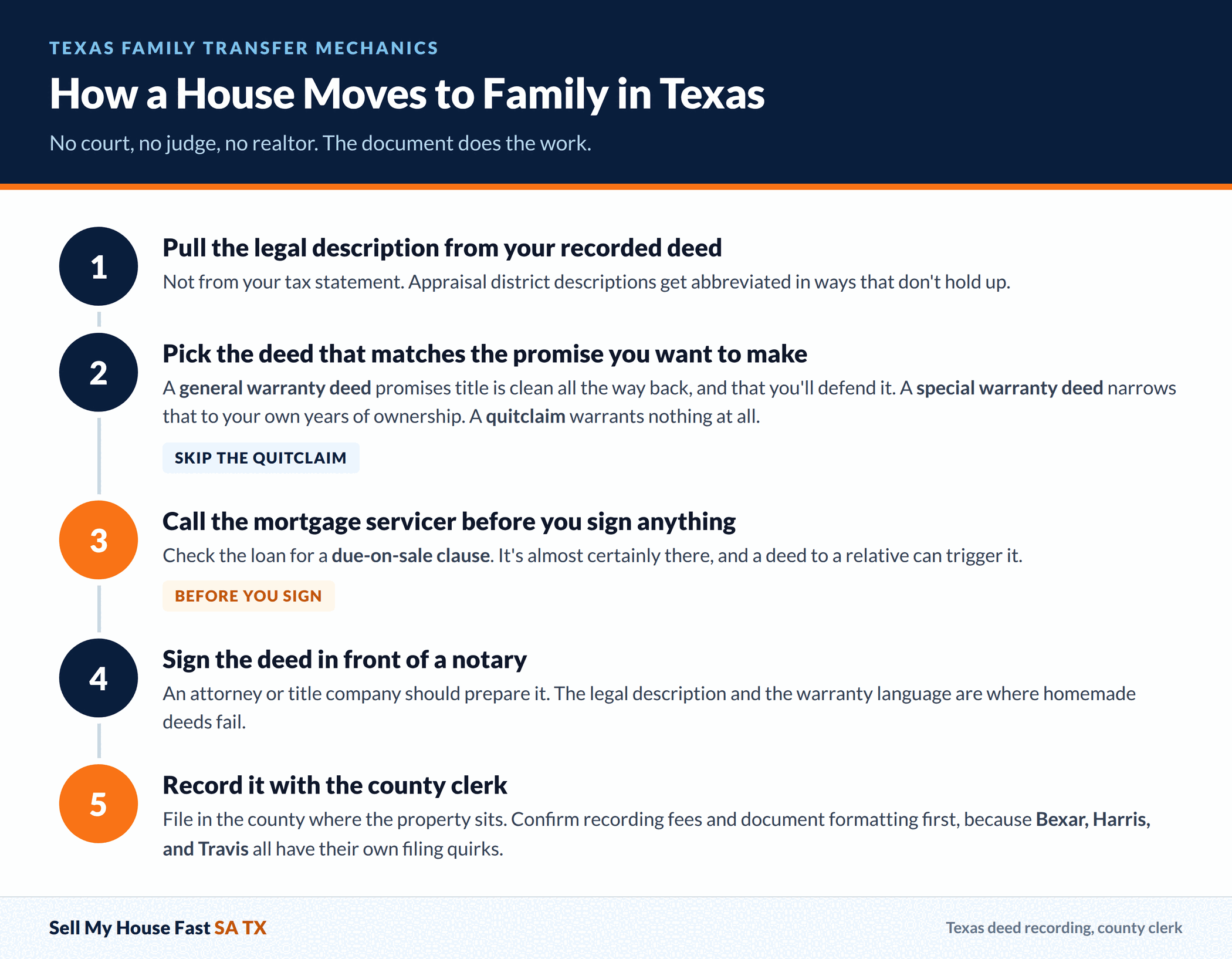
Start with the mechanics. A Texas transfer runs on a deed, signed in front of a notary, then recorded with the county clerk in the county where the property sits. I’ve walked that route myself more times than I can count buying houses. No court, no judge, no realtor. The document does the work.
The deed you pick drives the outcome, though. A general warranty deed promises the grantee that title is clean all the way back, and that you’ll defend it. A special warranty deed narrows that promise to your own years of ownership, while a quitclaim hands over whatever interest you happen to have, warranting nothing at all.
Quitclaims are the most overused document in Texas family transfers, and I’d steer you away from one almost every time. Plenty of title companies won’t write a policy on a chain of title that includes one, and a future buyer’s lender may balk. You save nothing by using it.
Pull the legal description from your recorded deed, not from your tax statement, since appraisal district descriptions get abbreviated in ways that don’t hold up. Then confirm recording fees and document formatting with your county clerk’s office before you drive over. Bexar, Harris, and Travis all have their own filing quirks.
A few years back a young couple in Schertz called me on a Monday with orders to be in Denver in five weeks. Their plan was to deed the house to his brother and sort the money out later, but the mortgage servicer’s due-on-sale clause ended that idea fast. We closed instead, kayaks still hanging in the garage, and they drove out with cash rather than a half-finished family arrangement.
Check your loan for a due-on-sale clause. It’s almost certainly there. A deed to a relative can trigger it. Call the servicer before you sign anything.
How Do You Transfer Property Ownership From Parent to Child in Texas?
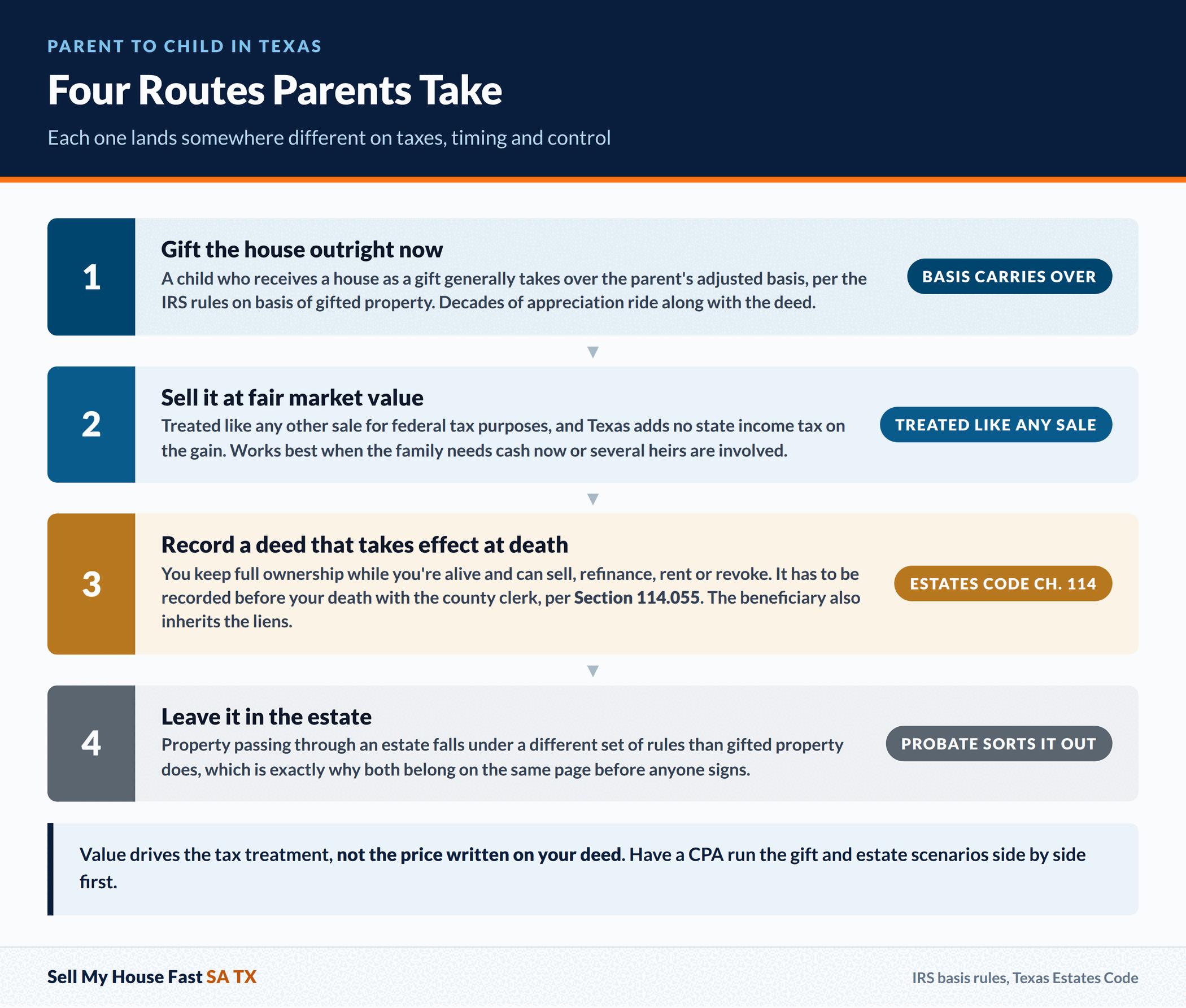
$333,611 was the statewide median sale price in August 2026, down 1.3 percent from a year earlier. Homes took a median of 68 days to sell, according to Redfin’s Texas market data. That number matters for parent-to-child transfers, because value drives the tax treatment, not the price written on your deed, and I’ve watched that trip up families doing these transfers.
There are four common routes parents take here. Gift the house outright now. Sell it at fair market value. Record a deed that takes effect at death. Or leave it in the estate and let probate sort it out.
The cost of gifting rarely comes up at the kitchen table. Per the IRS rules on basis of gifted property, a child who receives a house as a gift generally takes over the parent’s adjusted basis. Decades of appreciation ride along with the deed. Property passing through an estate falls under a different set of rules, so have a CPA run both scenarios side by side before anyone signs. I’ve seen that step skipped plenty of times. That one conversation can be worth more than the deed preparation fee ten times over.
Property tax exemptions deserve attention too. A transfer can disturb a homestead exemption, and any over-65 or disability benefits tied to the current owner don’t automatically follow the house. Your county appraisal district can tell you exactly what happens to your account and what has to be refiled.
One pattern I see constantly: parents deed the house to one child and assume the other kids will understand, but that assumption rarely holds up. If the goal is fairness among several children, a sale with the proceeds divided beats a deed to a single sibling every time.
Can You Partially Transfer a Deed to a Family Member in Texas?
Maria wanted to leave her daughter a one-quarter share of her house. She asked whether a deed could do that. It can. A deed can convey half a house, a third, or an undivided one-eighth interest, and the clerk files it away without asking questions. Families feel the rest later. Every fractional owner gets a say in any future sale, and one holdout can freeze the property for years.
Partial transfers show up most often with rural land and inherited homes. A parent adds a daughter to the deed thinking it simplifies things, but then the daughter divorces, or a creditor attaches her interest, or she simply disagrees about price.
Selling into a crowded market with a fractional interest is rough. Greater Houston carried 38,947 active listings in August 2026 with inventory steady at 5.3 months, per the Houston Association of Realtors. Buyers with that much choice don’t wait around for four cousins to agree on a counteroffer.
If the house is a homestead and you’re married, your spouse generally needs to sign the deed, even if only your name appears on title. Skipping that signature creates a defect somebody has to clean up later, usually at the worst possible moment.
A partition suit is the legal remedy when co-owners deadlock, and it’s slow, public, and expensive. Courts can order the land divided or sold at the parties’ cost.
Buying out a relative’s fractional share is usually cleaner than litigating it. We’ve worked both sides of this, where one heir kept the house and we funded the buyout of the others, and the reverse. Both worked because everyone got cash instead of a lawsuit. When a family needs a firm number to make that math work, Sell My House Fast SA TX will put an offer in writing at no cost. Use it purely as a benchmark if you like.
Does a Transfer on Death Deed Work for Family Property Transfers in Texas?
For one house going to one adult child, a transfer on death deed is the best cheap tool Texas law gives a homeowner. It does one job and does it well.
Chapter 114 of the Estates Code governs it. The deed has to include the formalities of a recordable deed and state that the transfer happens at your death. It also has to be recorded before your death with the county clerk where the property is located, according to Section 114.055. An unrecorded one does nothing at all.
You keep full ownership while you’re alive. Sell it, refinance it, rent it out, revoke the deed and name someone else. The beneficiary has no interest until you’re gone. A TODD also needs no notice to the beneficiary and no consideration, and it isn’t treated as a transfer that trips a due-on-sale clause. When it’s properly recorded, the real estate skips probate entirely, as TexasLawHelp explains.
The part that disappoints people: the beneficiary inherits the liens. A mortgage, a tax lien, a contractor’s lien, all of it rides along. Estate creditors can still reach the property in certain circumstances, so this isn’t asset protection.
Naming three children as beneficiaries recreates the fractional ownership problem I described earlier, just with a delay fuse. The Texas State Law Library’s guide on transferring property after death is a solid starting point. Your county clerk can also check whether a TODD already exists on your property.
My honest take: a TODD is a fine tool and a poor substitute for a plan. If the house needs a new roof and nobody in the family can cover it, deferring the decision to a beneficiary doesn’t fix the roof.
What Gift Tax Implications Should Texas Families Know About?
A dad signs a gift deed in March and feels great about it. His daughter sells two years later and writes a check for capital gains that accumulated while he owned the place.
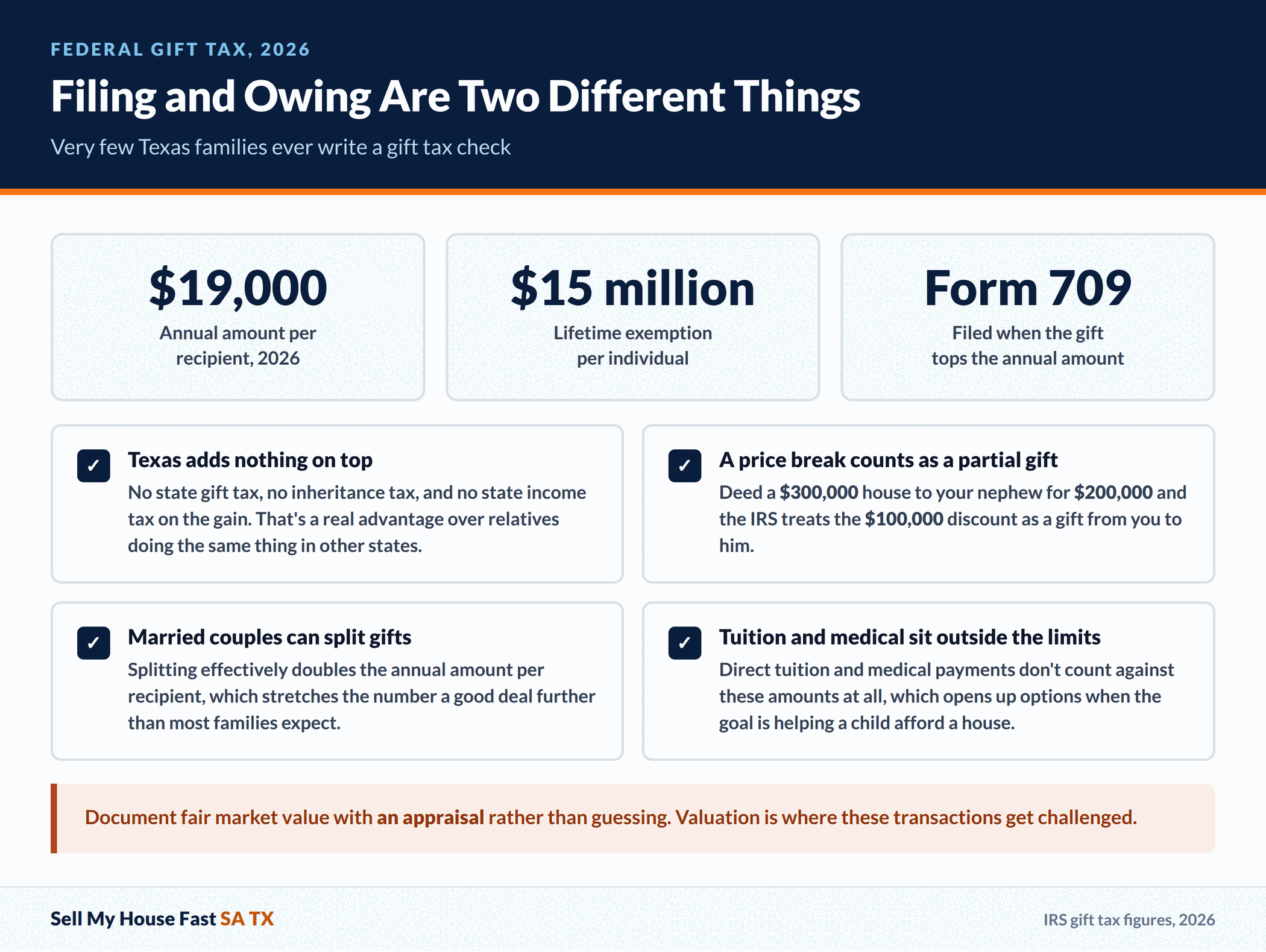
Families often dread federal gift tax rules more than they should. For 2026 you can give any one person up to $19,000 without touching your lifetime exemption. That lifetime figure sits at $15 million per individual. A house worth more than the annual amount means filing Form 709, but filing and owing are two different things. Very few Texas families ever write a gift tax check.
Texas itself doesn’t levy a gift tax or an inheritance tax, and there’s no state income tax on the gain either. That’s a real advantage over relatives doing the same thing in other states.
Selling below market value counts as a partial gift. Deed a $300,000 house to your nephew for $200,000. The IRS treats the $100,000 discount as a gift from you to him. Document the fair market value with an appraisal rather than guessing, because valuation is where these transactions get challenged.
A bargain sale does something to your own tax picture too. Sellers focus on the buyer’s side and forget that a below-market price can strand them with less cash than a straight sale would have produced. That shows up after the loan payoff and closing costs.
Married couples can split gifts and effectively double the annual amount per recipient. Direct tuition and medical payments sit outside these limits altogether, which opens up options when the real goal is helping a child afford a house rather than handing them one.
How Do You Sell a House to a Family Member in Texas?
Families picture a handshake price, a title company, and a closing in three weeks. Then the lender orders an appraisal, the appraisal lands well under the agreed number, and the bank refuses to fund the difference because the parties are related.
Lenders call these non-arm’s-length transactions, and they scrutinize them hard. Underwriters want a written contract, an independent appraisal, and a gift-of-equity letter if any discount is involved, and in my experience they’ll flag the file if any of those pieces are missing. Some loan programs restrict them further when the seller keeps living in the house.
Run the sale through a title company anyway. Yes, you trust your sister. Title work catches the old lien nobody remembered, the survey gap at the back fence, and the deceased uncle who never got removed from the chain.
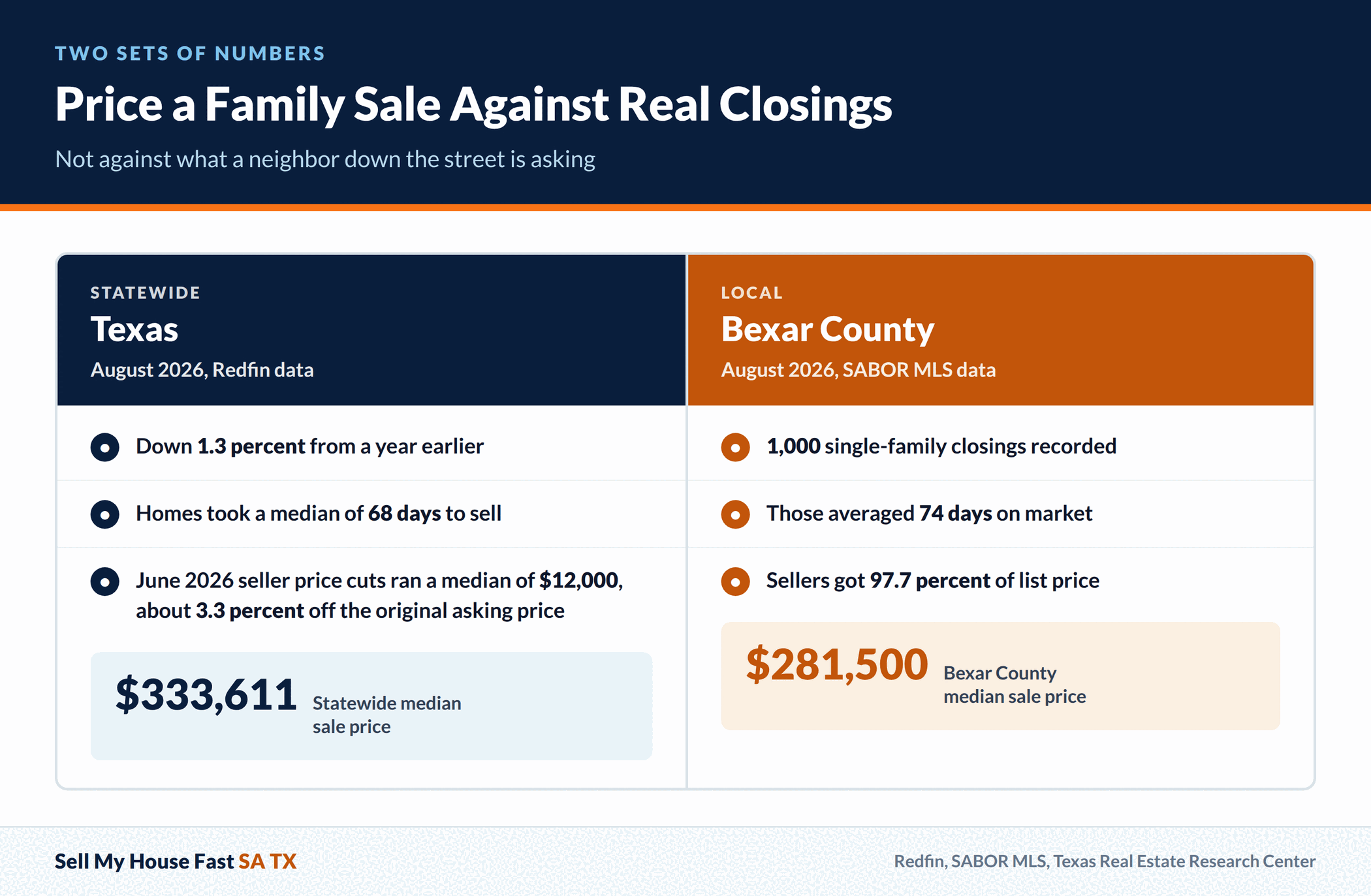
Price it against real closings, not against what a neighbor is asking. Bexar County recorded 1,000 single-family closings in August 2026 at a median of $281,500. Those averaged 74 days on market and 97.7 percent of list price, per SABOR MLS data. Statewide, the Texas Real Estate Research Center reported June 2026 seller price cuts running a median of $12,000, about 3.3 percent off the original asking price. Sellers anchored to 2022 values are the ones sitting, and I’ve watched that stall a sale for months.
An owner in Pasadena reached me after two listing agreements expired back to back. Neither one drew a single offer. Her cousin wanted the house but couldn’t qualify, and the listing photos still showed the foundation crack along the back wall that scared off every financed buyer. We bought it as-is and she stopped paying to maintain a house she’d already moved out of.
When a family sale stalls on financing or condition, a cash buyer is sometimes the kinder answer. Sell My House Fast SA TX buys across San Antonio and the surrounding counties without repairs, commissions, or appraisal contingencies.
Frequently Asked Questions
How Do I Get My House Title Into a Relative’s Name in Texas?
You’ll sign a properly drafted deed in front of a notary. Then you record it with the county clerk in the county where the property sits. An attorney or title company should prepare it, since the legal description and warranty language are where homemade deeds fail. Contact your mortgage servicer first if there’s still a loan on the property, because transferring title can give the lender the right to call the balance due.
What Taxes Come Into Play When I Sell My House to a Relative?
Selling at genuine fair market value is treated like any other sale for federal tax purposes, and Texas adds no state income tax on your gain. Give your relative a price break and the IRS generally views the discount as a gift from you. That may mean filing a gift tax return, even though the federal exclusions described above usually prevent any tax from being owed. Ask your appraisal district what the transfer does to your homestead and any age-based exemptions, since those don’t transfer automatically.
Which Transfer Method Is the Best One to Use?
It depends entirely on when you want the house to change hands and whether money is moving. If you want to keep living there and pass it on later, the death deed discussed above is hard to beat on cost and simplicity. If the family needs cash now, or repairs are piling up, or multiple heirs are involved, a real sale with proceeds split beats any deed maneuver. A CPA plus a real estate attorney will save you far more than they charge.
If you’re weighing a family transfer against a straight sale and want to talk it through with someone who’s done both sides of it, we’re glad to listen. Call or email us, ask your questions, and take whatever’s useful. No pressure, no obligation, and no hard feelings if you decide the deed route is right for your family.
What the San Antonio Numbers Say About a Family Sale
Bexar County closed 1,000 single-family homes in August 2026 at a median of $281,500, and those houses averaged 74 days on market. Use that median as your reference point when you set a family price. It gives you a number you can defend to a lender, a CPA, or a sibling who wasn’t in the room. Our San Antonio page shows how we look at houses here, and the same approach holds in Schertz and the rest of the surrounding counties.
Price a house to a relative far under that median and the gap becomes a gift in the eyes of the IRS. Get an appraisal, write the number down, and file it with your copy of the deed. If your relative can’t qualify and the house needs work, a straight cash sale with the money split often leaves the family in better shape than a discounted transfer nobody can finance.
Talk It Through Before You Sign
We buy houses in San Antonio and the counties around it, and we’ve been on both sides of family transfers plenty of times. If you want a firm cash number to weigh against a gift deed or a transfer on death deed, we’ll put one in writing at no cost, and you’re free to take it to your attorney and do nothing with it. Ask us whatever you want on our contact us page. The form below reaches us too, and it takes about a minute to fill out.