
A deed doesn’t care that someone died. It still says exactly what it said the day it was signed, and the name on it belongs to a person who can’t sign anything anymore. Texas families hit that wall about three weeks after the funeral. Usually a title company asks the simple question nobody can answer: who owns this house now? The law of Texas already chose the heirs at the moment of death. It just didn’t send anyone a letter about it.
What Happens in Texas When Someone Dies Without a Will?
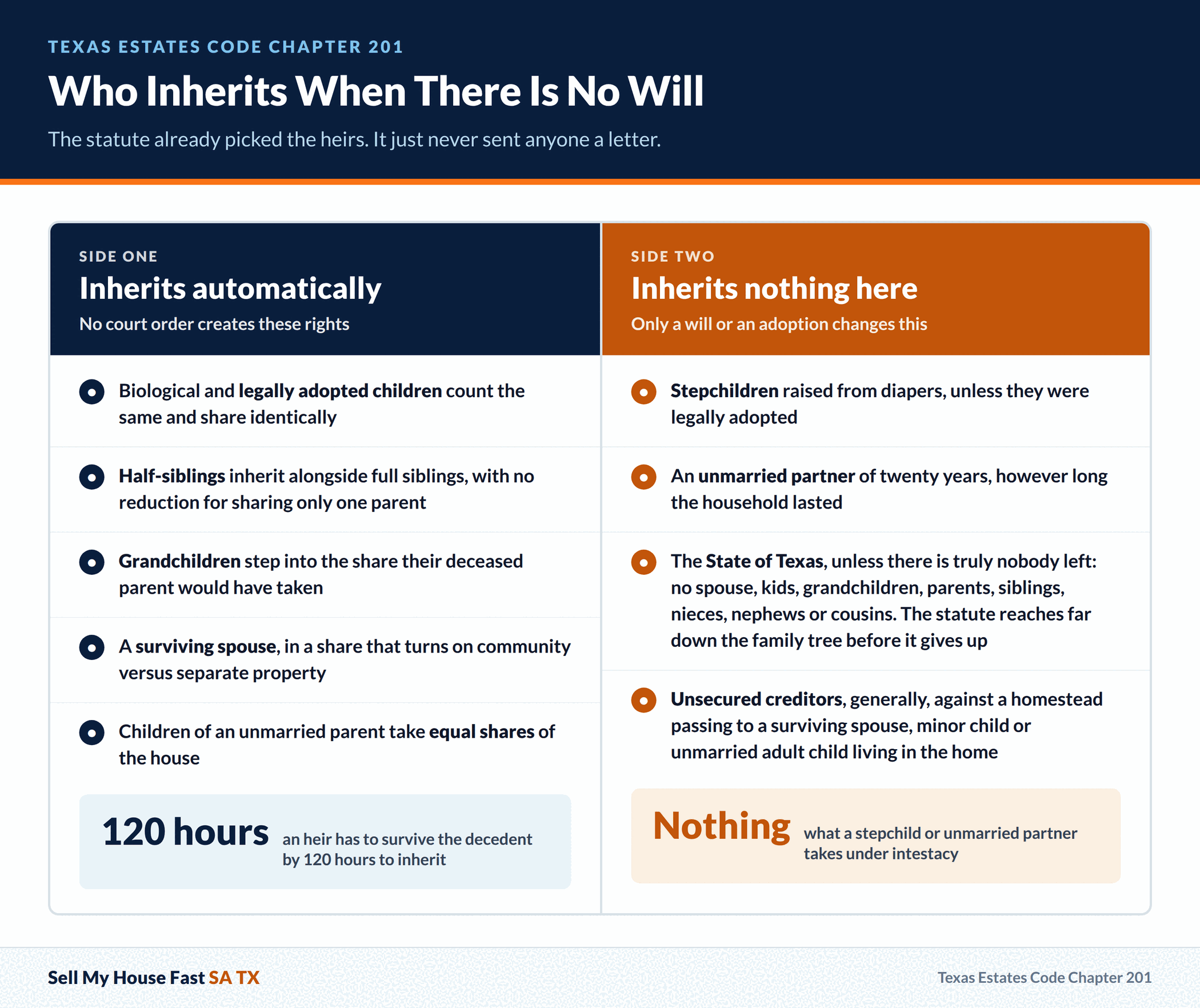
No, the state doesn’t take the house. That fear comes up in nearly every first phone call I get from an heir, and it’s close to groundless. The state only ends up with Texas property when there’s truly nobody left. No spouse, no kids, no grandchildren, no parents, no siblings, no nieces or nephews, no cousins. The statute reaches far down the family tree before it gives up.
What happens instead is that Chapter 201 of the Texas Estates Code writes the will for you. Lawyers call these the laws of descent and distribution. The State Law Library’s plain-English summary of intestate succession lays out the factors the court weighs. It turns on whether there’s a surviving spouse, whether the property was community or separate, and which relatives are still living.
Dying intestate doesn’t mean chaos. It means a default plan you didn’t write.
One wrinkle gets missed constantly. A person can die partly intestate, holding a valid will that never mentioned the rent house bought in 2019. That asset passes under intestacy rules even though a will exists. And instead of an executor named by the decedent, the probate court appoints an administrator, someone the judge picks to pay debts and hand out what’s left.
What Property Counts as Part of the Intestate Estate in Texas?
The median San Antonio home sold for $265,000 over the three months ending in August 2026, according to Redfin’s market data, with homes averaging 58 days on market. For most families I work with, that house is the whole estate, so everything else is just a checking account and a truck.
Intestacy only reaches assets that actually go through probate. A payable-on-death bank account goes straight to the named person. A life insurance payout goes to whoever’s named as beneficiary. A retirement account with a living beneficiary skips the courthouse entirely, and property held in a revocable living trust never enters the estate at all. Real estate titled in the decedent’s name alone is the asset that almost always drags the family into probate.
A few years back a widow in Leon Valley called me about her husband’s house after he passed with no will. Her contractor’s estimate to redo the kitchen came in higher than what the finished kitchen would have added to the sale price. The harvest-gold wall oven was still bolted in from the original build. We walked it on a Tuesday. She sold it as it stood rather than sink her savings into cabinets she’d never cook on.
Condition and title trouble stack on top of each other in inherited homes more often than not.
Who Are the Heirs to a Texas Estate Without a Will?
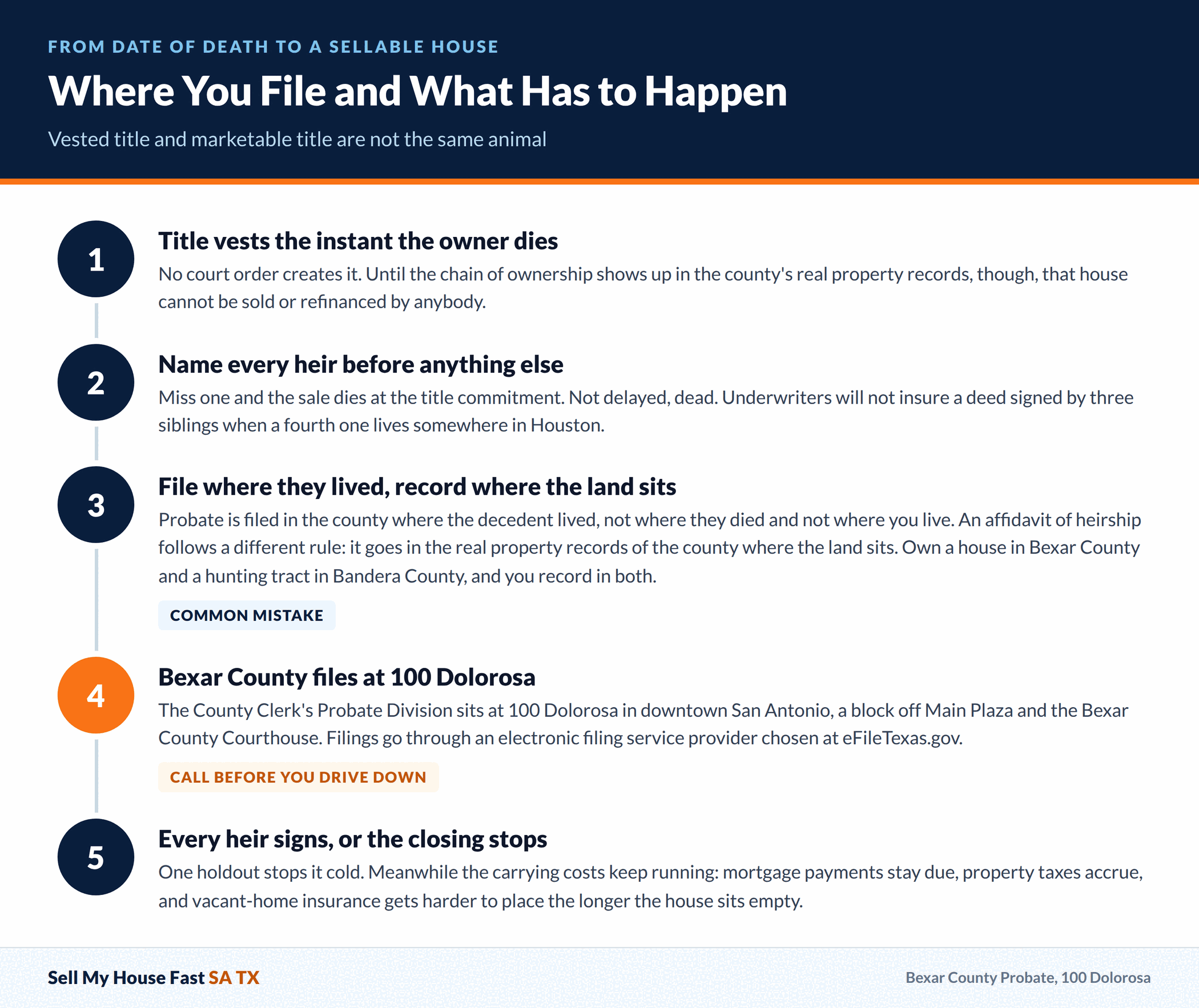
Miss one heir and the sale dies at the title commitment. Not delayed, dead. Underwriters will not insure a deed signed by three siblings when a fourth one lives somewhere in Houston, and a buyer’s lender won’t fund without that policy.
Biological and legally adopted children count the same and share identically, since adoption gives a child the same rights as a child born into the marriage. Half-siblings inherit alongside full siblings without any reduction for sharing only one parent. Grandchildren step into the share their deceased parent would have taken.
Stepchildren raised from diapers inherit nothing under intestacy unless they were legally adopted. Same for an unmarried partner of twenty years. I’ve watched that one fact split families in two. It’s the strongest argument I know for anyone reading this to go make an estate plan while they still can.
There’s also a timing rule worth knowing. An heir has to survive the decedent by 120 hours to inherit under Texas intestacy law. When a couple dies days apart, that window decides whose family the property lands in.
Heirship gets complicated fast with prior marriages, children born outside marriage, or a common-law marriage nobody ever formalized on paper. Probate litigation over heirship is expensive, slow, and avoidable. An attorney sorting it out early costs a fraction of one sorting it out after a contract falls apart.
Does Texas Community Property Change Who Inherits?
For years I assumed a surviving spouse in Texas simply kept the house. Wrong, and not even close in blended families.
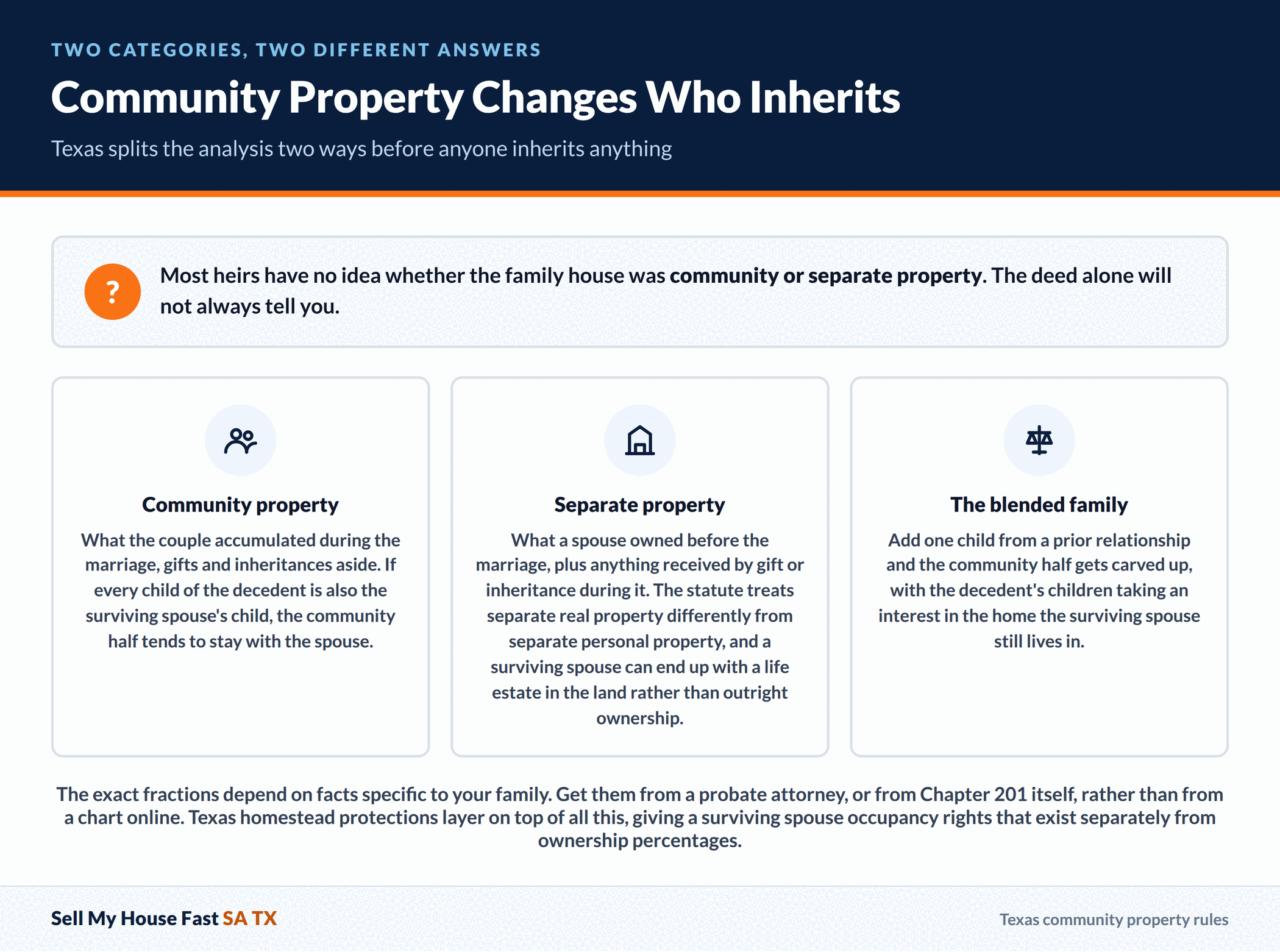
Texas splits the analysis two ways before anyone inherits anything. Community property covers what the couple accumulated during the marriage, gifts and inheritances aside. Separate property covers what a spouse owned before the marriage, plus anything received by gift or inheritance during it, so the two categories end up following completely different distribution schemes.
The blended family is where this turns sharp. If every child of the decedent is also the surviving spouse’s child, the community half tends to stay with the spouse. Add a child from a prior relationship and that community half gets carved up, with the decedent’s children taking an interest in the home the surviving spouse still lives in. The statute also treats separate real property differently from separate personal property. A surviving spouse can end up with a life estate in the land rather than outright ownership.
Most heirs have no idea whether the family house was community or separate property. The deed alone won’t always tell you.
The exact fractions depend on facts specific to your family. Get them from a probate attorney, or from Chapter 201 itself, rather than from a chart online. I’ve seen buyers rely on the wrong percentage and stall a closing for weeks. Texas homestead protections layer on top of all this too, giving a surviving spouse occupancy rights that exist separately from ownership percentages.
What Happens to the Texas House Itself?
Three siblings inherited a brick ranch off Bandera Road, and each believed the oldest had handled the paperwork. Fourteen months later the taxes were delinquent. The insurance had lapsed after the carrier learned the named insured had died. A busted supply line had soaked the back bedroom.
Title to a Texas house vests in the heirs the instant the owner dies. No court order creates it. The catch is that vested title and marketable title aren’t the same animal. Until the chain of ownership shows up in the county’s real property records, that house cannot be sold or refinanced by anybody.
Every heir with an interest has to sign the deed. One holdout stops the closing cold.
Meanwhile the carrying costs keep running. Mortgage payments stay due, property taxes accrue, and vacant-home insurance gets harder to place the longer the house sits empty. I’ve seen more equity evaporate from deferred maintenance during a stalled estate than from any price negotiation at the closing table. Families who clean up title quickly, then decide calmly whether to keep or sell, come out ahead of the ones who freeze. If the group wants a straightforward exit, Sell My House Fast SA TX can work with the heirs and the title company. The timeline matches when the paperwork clears instead of some artificial deadline.

Do I Need to Probate an Estate in Texas Without a Will?
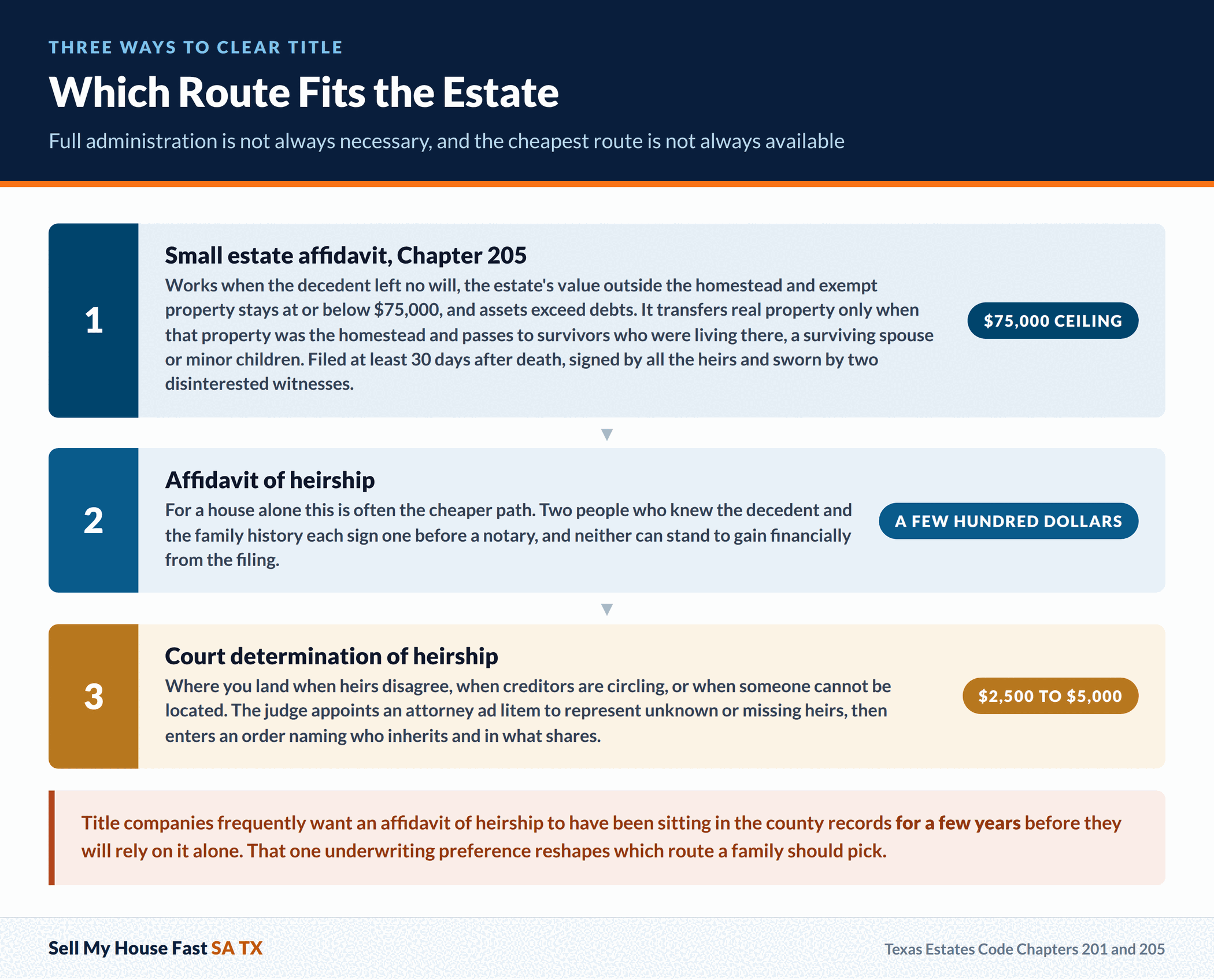
Title companies frequently want an affidavit of heirship to have been sitting in the county records for a few years before they’ll rely on it alone. That one underwriting preference reshapes which route a family should pick, and it rarely shows up in articles about probate law.
Full administration isn’t always necessary. The small estate affidavit under Chapter 205 works when the decedent left no will, the estate’s value outside the homestead and exempt property stays at or below $75,000, and assets exceed debts. It can transfer real property only when that property was the homestead and passes to survivors who were living there, a surviving spouse or minor children. The affidavit gets filed at least 30 days after death, signed by all the heirs and sworn by two disinterested witnesses.
For a house alone, an affidavit of heirship is often the cheaper path. Two people who knew the decedent and the family history each sign one before a notary. Neither can stand to gain financially from the filing.
When heirs disagree, when creditors are circling, or when someone can’t be located, you’re looking at a court determination of heirship instead. The judge appoints an attorney ad litem to represent unknown or missing heirs. The judge then enters an order naming who inherits and in what shares. Texas also enforces a four-year deadline to probate a will after death. In my experience buying houses, a forgotten will found in year five often leaves a family in intestacy anyway.
Where Do I File for Probate in Texas?
A seller called me from Universal City, convinced she had to file in Travis County because her mother had died in an Austin hospital. She’d lived in Converse for thirty years, though, and that’s where the case belonged.
Probate is filed in the county where the decedent lived, not where they died and not where you live. An affidavit of heirship follows a different rule. It’s recorded in the real property records of the county where the land sits. Own a house in Bexar County and a hunting tract in Bandera County, and you record in both.
Bexar County runs its probate filings through the County Clerk’s Probate Division at 100 Dolorosa in downtown San Antonio. That’s a block off Main Plaza and the Bexar County Courthouse. Filings go through an electronic filing service provider chosen at eFileTexas.gov.
One more thing families don’t expect. Bexar County’s probate guidance makes clear that applying for letters of administration or a determination of heirship generally means hiring an attorney. A non-lawyer representing an estate’s beneficiaries and creditors amounts to practicing law without a license. Clerks can’t give legal advice, but they can tell you current filing fees and which court your case lands in.
Call before you drive down there. Court procedures shift, and a five-minute phone call saves a parking garage fee and an afternoon.
Selling a Texas House You Inherited Without a Will
Heirs picture a quick listing, a spring closing, and a check split three ways by summer. Then the title company requests an heirship determination, the estimate for the roof comes back, and the youngest sibling in Dallas stops returning texts. Financing isn’t helping the buyer pool either. Freddie Mac’s 30-year fixed averaged 6.66% for the week of July 30, 2026, so buyers are picky and slow. San Antonio recorded 3,011 home sales in August 2026, down from the prior August, which tells you demand is steady rather than hungry.
A retail listing makes sense when the house shows well, the heirs agree, and title is already clean. Skip the cosmetic upgrades most agents suggest, because buyers in this market discount for condition rather than reward fresh paint over a failing HVAC system.
One landlord in Seguin reached out about a rental he’d inherited from an aunt. Three decades of belongings were still stacked inside. The garage held paint cans and a motorcycle in pieces nobody could identify. His siblings wanted out clean, no cleanout weekends, no contractor estimates. We bought it loaded, and they kept what fit in two pickup beds.
Selling as-is to a direct buyer like Sell My House Fast SA TX isn’t the right answer for everyone. When the heirs live in three cities and the house needs work, though, the arithmetic usually favors speed.
Frequently Asked Questions
Who Gets the House If a Parent Dies Without a Will in Texas?
If your parent was unmarried at death, the children inherit in equal shares, with grandchildren taking the share of any child who died first. If your parent was married, the answer turns on the community versus separate property analysis described earlier. It also turns on whether all the children belong to that marriage. A blended family almost always produces co-ownership between the surviving spouse and the children.
What Does It Cost to Handle Probate in Texas When There’s No Will?
Cost tracks complexity more than anything else. An affidavit of heirship recorded with the county clerk runs a few hundred dollars in preparation and recording fees. A judicial determination of heirship with a court-appointed attorney ad litem usually lands in the $2,500 to $5,000 range, once you add filing fees, citation service, and the ad litem’s fee. Add an administration on top of that, and the number climbs again. Contested matters have no ceiling worth naming.
Can One Heir Sell the House Without the Others Signing?
No. An heir can sell only that heir’s fractional interest. Almost no buyer wants it, and no title company will insure it as a clean transfer. To convey the whole property, every heir has to sign, or the estate needs an administrator with court authority to sell. This is why one silent sibling can stall a closing for months.
How Long Does an Heirship Determination Take in Bexar County?
Plan on three to six months from filing to signed judgment, assuming the heirs are cooperative and locatable. The attorney ad litem has to investigate and report, and that step alone eats several weeks. Missing heirs, minors, or disputes push the timeline past a year.
Do We Have to Pay the Deceased Person’s Debts Before Selling?
Secured debts follow the property. A mortgage, tax lien, or HOA assessment gets paid at closing whether anyone probates or not. Unsecured debts like credit cards are a different question, and the answer depends on whether an administration is opened and how the claims are classified. Talk to a probate attorney before you write checks to collectors out of your own pocket.
Is the Homestead Protected From Creditors After Death?
Generally yes, when the homestead passes to a surviving spouse, minor child, or unmarried adult child living in the home. Texas homestead protections survive death for qualifying heirs, which is one reason the family home often stays out of reach of unsecured creditors while other assets get consumed.
Where That Leaves You
Dying without a will in Texas doesn’t mean the state takes the house. It means the statute picks your heirs, the fractions get awkward, and somebody has to do the paperwork before anyone can sell, refinance, or borrow against the property. The sooner you sort out who owns what, the cheaper the fix.
If you own an inherited San Antonio house, you may be weighing whether it’s worth repairing, listing, or letting go. We’re glad to talk it through and tell you plainly if a direct sale doesn’t fit. No pressure, no obligation, and no hard feelings if you decide to keep it in the family.
What This Means for San Antonio Heirs
San Antonio isn’t a frantic market right now, and that helps a family that needs time to sort out heirship. The median home here sold for $265,000 over the three months ending in August 2026, and listings averaged 58 days on market. Two months of showings is a long stretch to carry taxes, insurance, and a mortgage on a house nobody lives in. If the heirs agree and title is already clean, a listing can still be the better route. If the paperwork is stuck and the house needs work, selling your San Antonio house as it stands keeps those carrying costs from eating the inheritance.
Where to Start
You don’t have to know which route fits before you talk to somebody. Tell us who the heirs are, what shape the house is in, and where the paperwork stands. We’ll say plainly whether an affidavit or a court determination looks like the cheaper path, even when that answer means we aren’t the buyer. When you’re ready, you can contact us here. You can also fill in the form below with the address, and we’ll follow up with a cash offer and no obligation to take it.