


You walked through the house last Tuesday and wrote down a list. Roof shingles curling at the edges. HVAC making that grinding noise you’ve ignored for two summers. Bathroom tile cracked, plumbing slow, one bedroom door that won’t latch. By the time you reached the back fence, the list had sixteen items on it. That was before you even looked at the foundation.
Most homeowners in your position freeze. They assume every item has to be fixed before they can sell anything. In Texas that assumption is wrong, and spending months acting on it can cost you more than the repairs themselves. That one belief keeps more people stuck than any contractor ever has.
Selling a house that needs work doesn’t mean giving the place away. It means knowing your real options and pricing the situation honestly. Do that and you keep the most money in your pocket when it’s over.
What It Actually Means to Sell As-is in Texas
An as-is sale doesn’t mean selling in secret. Selling a house as-is means listing the property in its current condition, with no repairs before closing. Texas law still requires sellers to disclose known material defects. Listing as-is tells buyers the price reflects the current condition and that no repairs follow the inspection. That distinction matters. You’re not hiding anything; you’re setting expectations upfront.
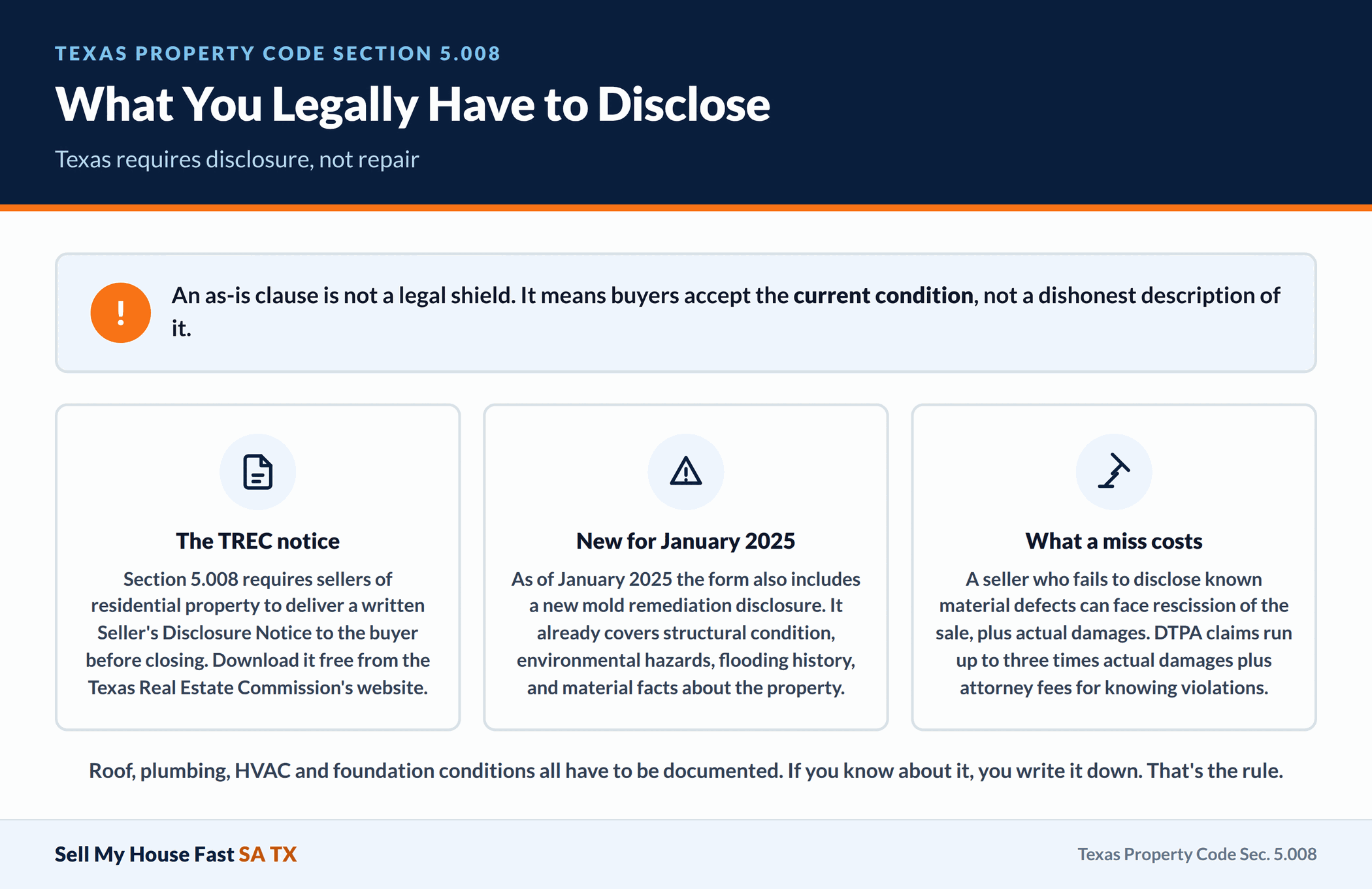
Texas Property Code Section 5.008 requires sellers of residential property to deliver a written Seller’s Disclosure Notice to the buyer before closing. The TREC Seller’s Disclosure Notice covers structural condition, environmental hazards, flooding history, and material facts about the property. As of January 2025, the form also includes a new mold remediation disclosure. You can download it free from the Texas Real Estate Commission’s website. Fill it out completely and honestly. Guesswork on that form is not a defense later. Sellers who hide a leaking roof or a known foundation problem, and I’ve watched both come back to bite people, open themselves to real legal exposure after closing. That risk doesn’t disappear because the property changed hands.
I’ve seen sellers get tripped up on this more times than I can count. They think “as-is” is a legal shield. It isn’t. What the clause actually protects you from is a buyer coming back after inspection and demanding you replace an aging water heater on your dime. Disclosure rules and the as-is clause are two different things. Mixing them up gets costly.
Disclosure forms cover structural conditions, roof age, plumbing, electrical systems, flooding history, and any known defect that affects property value or safety. Roof, plumbing, HVAC, and foundation conditions all have to be documented. If you know about it, you write it down. That’s the rule.

The Real Math on Repairs Before Listing
Most sellers assume that fixing everything before listing earns back every dollar spent. The data says otherwise, and that assumption costs people real money.
A while back I worked with a widow in Converse, just east of San Antonio. She was splitting assets from a divorce settlement and needed the house handled quickly. Her deadline came from the divorce decree, not from a contractor’s calendar. Before we ever talked, she’d collected estimates for a full kitchen remodel and a new HVAC system. Her garage was still packed with her ex-husband’s tools, half a pallet of old tile, and a riding mower that hadn’t run since 2019. We sat down and ran the numbers. She was about to spend money she didn’t have on renovations that wouldn’t come close to paying for themselves, a pattern I’ve watched derail plenty of otherwise clean sales. We bought the property as-is. She kept the equity she needed, and no contractor ever set foot on the property.
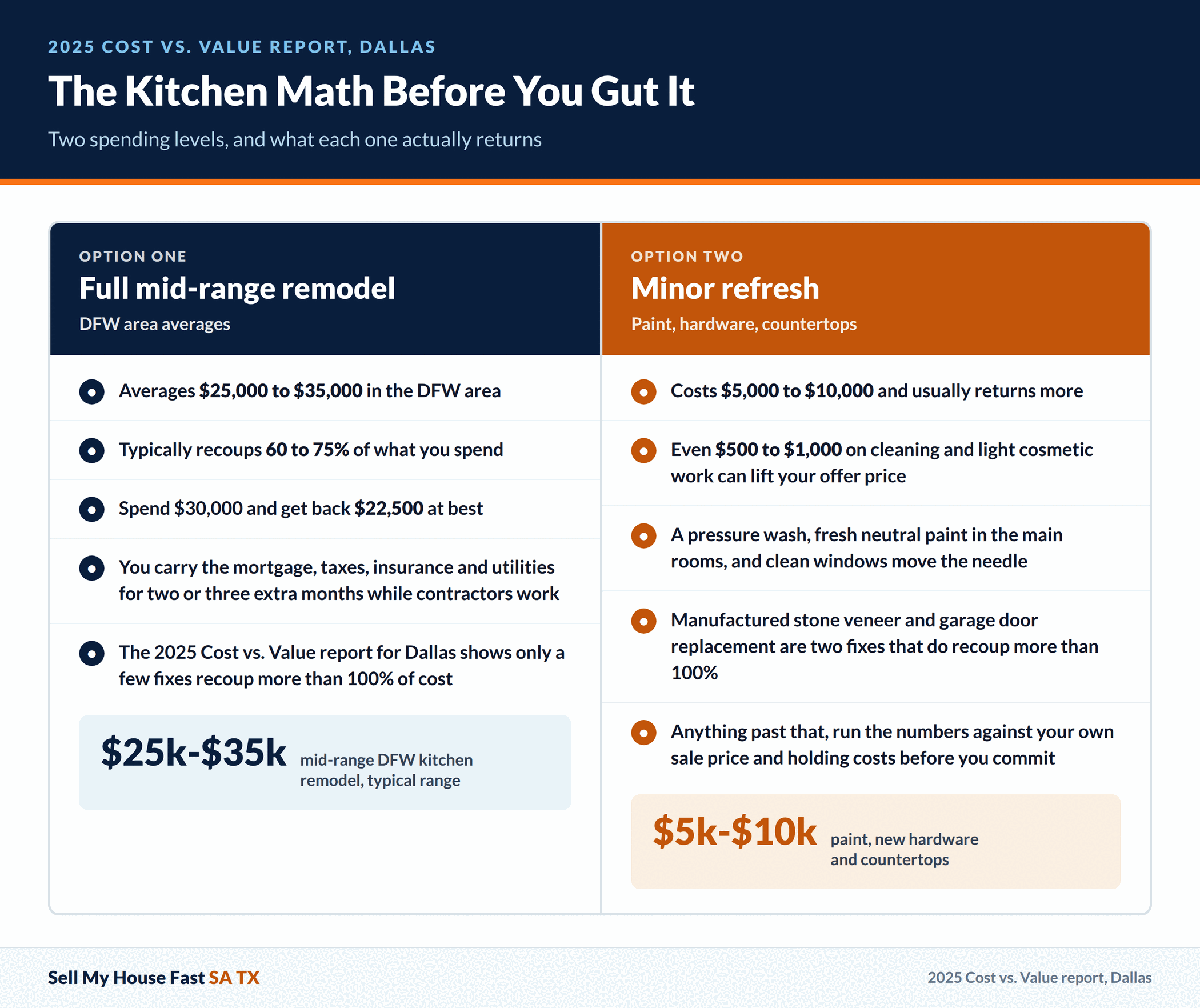
Most home improvements don’t pay for themselves when you’re getting ready to sell. The 2025 Cost vs. Value report for Dallas shows only a few fixes recoup more than 100% of cost. Manufactured stone veneer and garage door replacement are two of them. Everything else costs more than you’ll get back.
Take kitchens, which sellers always want to gut before listing. A mid-range kitchen remodel in the DFW area averages $25,000 to $35,000 and typically recoups 60 to 75% of that. A minor refresh with paint, new hardware, and countertops costs $5,000 to $10,000 and usually returns more. So you spend $30,000 and get back $22,500 at best. That is money out the door before a single offer arrives. Meanwhile you’re carrying the mortgage, taxes, insurance, and utilities for two or three extra months while contractors work. They always run long.
Even $500 to $1,000 spent on cleaning and light cosmetic work can lift your offer price. A pressure wash, fresh neutral paint in the main rooms, and clean windows move the needle without emptying your budget. Anything past that, run the numbers against your own sale price and holding costs before you commit. Paint is cheap. Contractors are not.
How Texas Buyers Think About Distressed Properties
Buyers in Texas aren’t all the same. Who makes an offer on your house comes down to how it’s priced and where it sits. Two identical floor plans can draw completely different offers.
As-is sales in Texas usually pull investors, fix-and-flip buyers, and buyers comfortable with renovation work. Think Alamo Heights, Terrell Hills, or the established zip codes around Fort Worth’s Near Southside. Buyers shopping at that price point often have cash and renovation experience. Foundation piers and an aging HVAC system don’t scare them, because they’ve budgeted for both. They just need the price to reflect reality.
Retail buyers using a bank loan are a different situation. A conventional mortgage lender requires a home appraisal, and the appraiser’s job is to flag material defects. A roof with active leaks, exposed wiring, missing stair handrails, or a water heater past its useful life can each sink a financed contract. That’s no moral judgment on your house, just how lenders manage risk, and underwriters don’t bend much. So if you list on the open market and price for a retail buyer, expect the inspection and appraisal to turn into a negotiation of their own.
Find out who’s actually shopping your neighborhood right now. That local buyer pool matters more than any general advice you’ll read online. Ask an agent for the last six months of comparable activity.
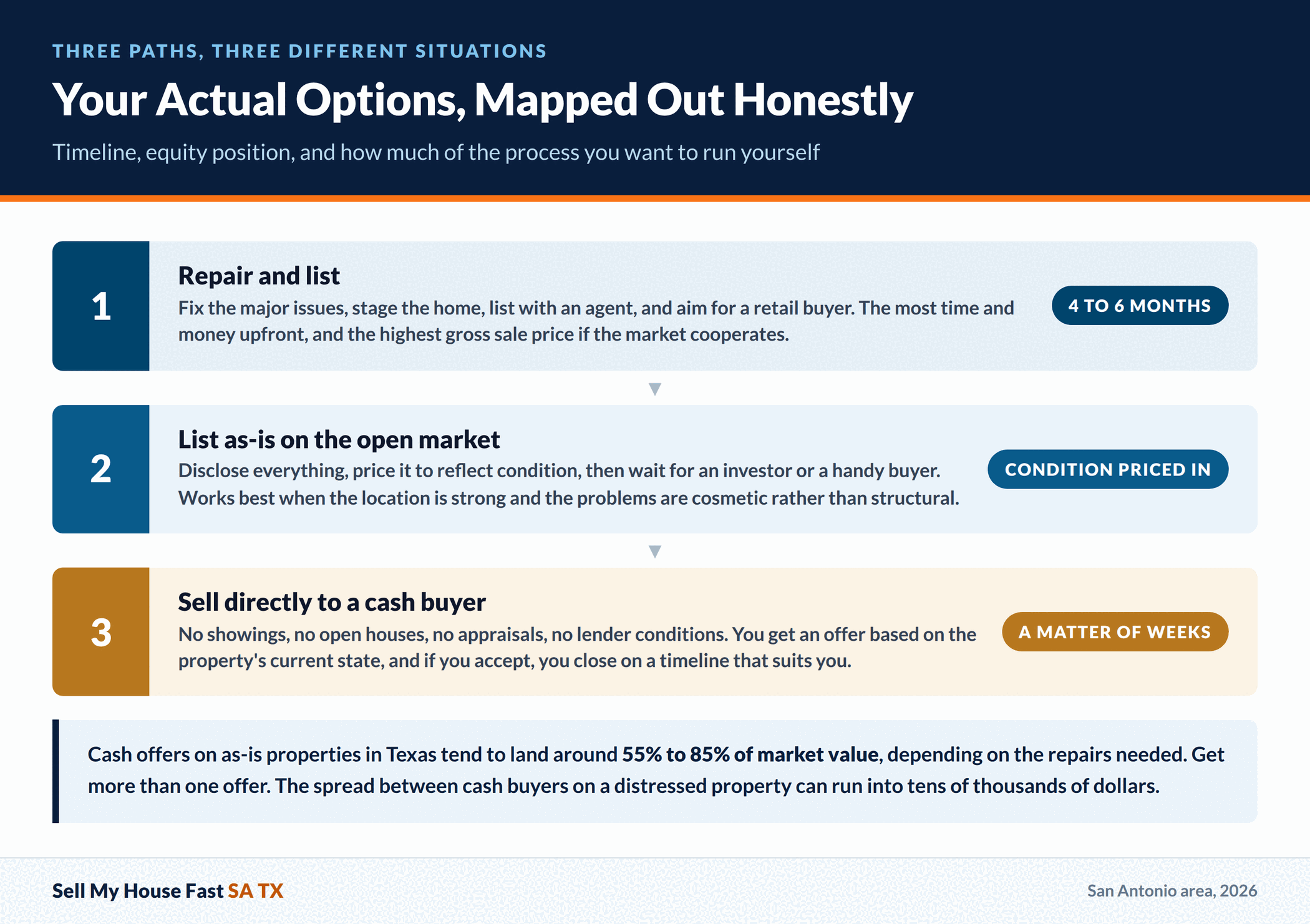
Cash offers on as-is properties in Texas tend to land around 55% to 85% of market value, depending on the repairs needed. That range is wide for a reason: the spread between a cosmetic fixer and a structurally compromised property is enormous. A house in Windcrest that needs paint and carpet is a different animal than one in Live Oak with a failed foundation and a denied roof insurance claim. Denied claims spook every buyer I’ve seen.

What the San Antonio Market Means for Your Sale Right Now
San Antonio’s market cooled off after the 2021 through 2023 frenzy, and sellers feel it. Over the three months ending July 2026, San Antonio home prices fell 2.2% from the same period a year earlier, selling at a median price of $268,000. Homes averaged 59 days on the market, up from 55 days the prior year.
New listings jumped 39% from February to March in San Antonio. That handed buyers more inventory and more negotiating room than they had in 2025. With choices, buyers get selective, and a weak listing gets skipped fast. A house in Castle Hills that needs a new roof and has deferred landscaping is competing against move-in-ready listings in the same price band. Competition punishes a distressed property harder than a turnkey one. Inventory is leverage, and right now it sits on the other side of the table.
Statewide numbers tell a similar story. In 2025, 335,390 homes sold across the state, up 1.3% from the prior year. The state average days on market rose to 67 days, roughly a week longer than 2024. A week doesn’t sound like much. For a seller carrying a mortgage on a property that needs repairs, that extra week on market is real carrying cost. Multiply that by a mortgage payment and it stops being a rounding error.
Pricing discipline matters more now than it did two years ago. In March 2025, 64.7% of home sales in Texas came with price reductions of at least $5,000. Sellers who list high and then chase the market down end up with less than if they’d priced it right on day one. A house with known issues, priced optimistically, sits. The longer it sits, the more buyers assume something is wrong beyond what’s disclosed.
The Carrying Cost Conversation Nobody Has with You
Carrying a house while you decide what to do costs money every single month. Run that calculation honestly and it usually changes a seller’s mind. Most people never total it up.
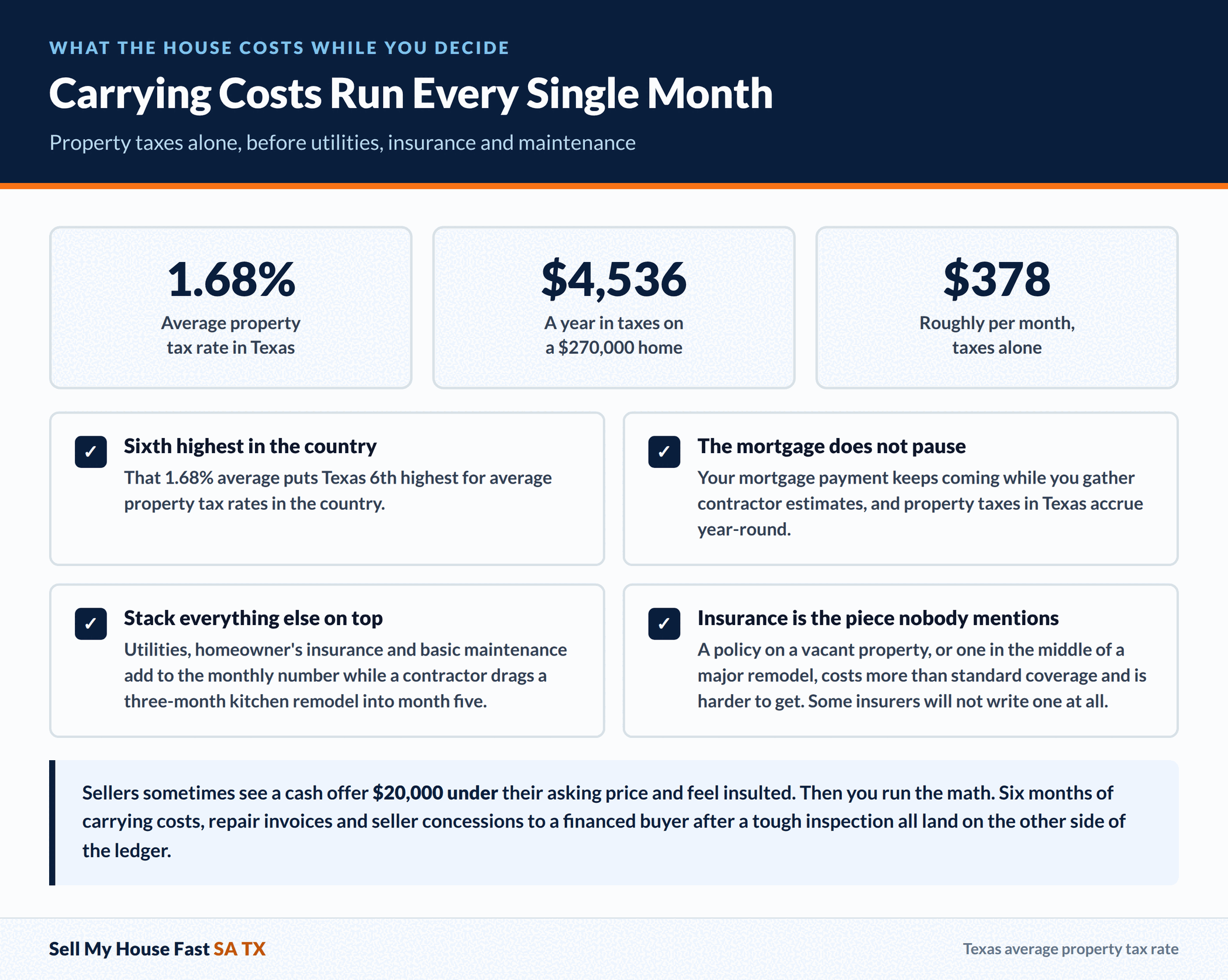
Your mortgage payment keeps coming while you gather contractor estimates. Property taxes in Texas accrue year-round. The average property tax rate in Texas is 1.68%, which puts Texas 6th highest for average property tax rates in the country. On a $270,000 home, that’s roughly $4,536 a year in taxes alone, or about $378 a month. Stack utilities, homeowner’s insurance, and basic maintenance on top. The number adds up fast while a contractor drags a three-month kitchen remodel into month five. None of that pauses while you wait on an estimate.
Sellers sometimes see a cash offer $20,000 under their asking price and feel insulted. Then we run the math. Six months of carrying costs, repair invoices, and seller concessions to a financed buyer after a tough inspection all land on the other side of the ledger. The gap shrinks to almost nothing, and the cash offer quietly wins on net proceeds.
Insurance is the piece nobody mentions. A homeowner’s policy on a vacant property, or on a property in the middle of a major remodel, costs more than standard coverage and is harder to get. Some insurers won’t write one at all on a home mid-renovation. That’s a real risk, and it can stall a sale or leave you exposed if something happens on the property during the work.

Your Actual Options, Mapped Out Honestly
You have three paths, and each one suits a different situation.
The first is repair-and-list. You fix the major issues, stage the home, list with an agent, and aim for a retail buyer. This path takes the most time and money upfront, and it can produce the highest gross sale price if the market cooperates. Homes in San Antonio are averaging nearly two months on market right now, so plan on four to six months from your first contractor call to closing. Scope of work alone can eat the first two months before you’ve even listed.
A second path is listing as-is on the open market, with an agent who knows distressed properties. You disclose everything, price it to reflect condition, then wait for an investor or a handy buyer. It works best when the location is strong and the problems are cosmetic rather than structural. Think dated fixtures, not foundation cracks.
The third path is selling directly to a cash buyer, which skips the listing process altogether. No showings, no open houses, no appraisals, no lender conditions. You get an offer based on the property’s current state, and if you accept, you close on a timeline that suits you. Companies like Sell My House Fast SA TX work in exactly this lane. They buy San Antonio-area homes regardless of condition, and condition here means everything, not just cosmetics. No repairs required, no commissions out of the proceeds.
Picking between them comes down to your timeline, your equity position, and how much of the process you want to run yourself. There’s no universal answer.

Foundation, Roof, Hvac: the Three Issues That Shape Every Texas Deal
Texas houses are hard on their systems. Clay soil runs through Bexar County, Travis County, and north into the DFW Metroplex. It shifts with moisture, and that movement cracks foundations. Summer heat runs air conditioners eight or nine months straight until something finally gives. Hail seasons in Central Texas and the Panhandle have been sending roofing contractors home with backlogged schedules for years.
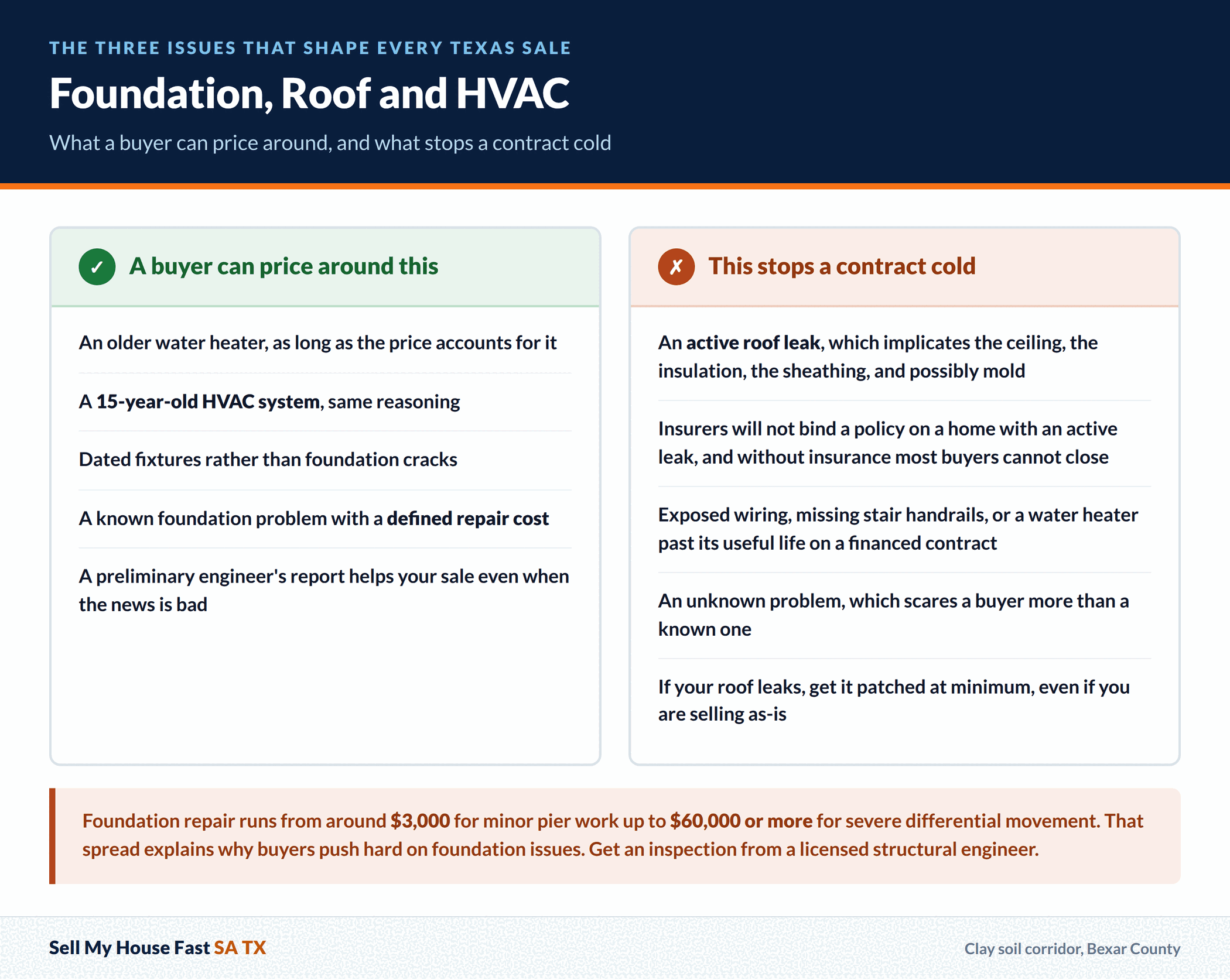
Get a foundation inspection from a licensed structural engineer, because expansive clay soils are common across North Texas, Central Texas, and the Gulf Coast corridor. Foundation repair runs from around $3,000 for minor pier work up to $60,000 or more for severe differential movement. That spread explains why buyers push hard on foundation issues. A preliminary engineer’s report helps your sale even when the news is bad. An unknown problem scares a buyer more than a known one with a defined repair cost.
Roof and HVAC issues land differently with a buyer. A buyer can live with an older water heater or a 15-year-old HVAC system if the price accounts for it. An active roof leak is harder to swallow, because it implicates the ceiling, the insulation, the sheathing, and possibly mold. If your roof leaks, get it patched at minimum, even if you’re selling as-is. An open leak can kill a contract outright. Insurers won’t bind a policy on a home with an active leak, and without insurance most buyers can’t close.
The Disclosure Requirement Is Your Friend, Not Your Enemy
Sellers sometimes go vague on the disclosure form, hoping to dodge a price negotiation. That backfires more often than it works, and it creates legal exposure that can follow you for years after closing. Vagueness reads as evasion to anyone reviewing the file later.
Failing to disclose a known defect gives buyers legal grounds to pursue damages after closing. An as-is sale doesn’t change that. “As-is” clauses mean buyers accept the current condition, not a dishonest description of it. The line is clear: you can sell a house with problems, but you can’t hide the ones you know about.
Full disclosure paired with honest pricing protects you, and it keeps the process moving instead of stalling. Buyers who know exactly what they’re getting, including the cracked tile, the aging HVAC, and the repaired plumbing under the master bath, are the buyers who don’t blow up a contract at inspection. Surprises kill contracts. Transparency keeps them alive.
Working with Cash Buyers and Investors in the San Antonio Area
A man called on a Thursday afternoon. Retired military, living in Universal City northeast of San Antonio. He’d inherited a rental property in the Converse area after his mother passed. He kept it rented for two years, trying to do right by the place, and he was done. The tenants had moved out. There were holes in the drywall, the fence was down on one side, and the detached garage was packed wall to wall with furniture and boxes nobody had touched in years. He wasn’t after top dollar. He wanted someone to take the property off his hands without drama, which in my experience is the most honest thing a seller can tell you.
That’s a case where a local cash buyer is genuinely the right answer. Holding that property while he sorted contractors, found new tenants, or waited on a retail buyer simply didn’t pencil out. Sell My House Fast SA TX handles exactly this kind of property. No cleaning, no repairs, no staging, just a cash offer based on what the house is actually worth in its current state. He signed, and that was the end of it.
If you’re going this route, get more than one offer. The spread between cash buyers on a distressed property can run into tens of thousands of dollars, depending on their renovation cost estimates and profit targets. A reputable buyer will walk you through how they got to their number. Expect that conversation, and expect the math to add up on paper.
Frequently Asked Questions
Can I Sell My House Even If It Needs Repairs?
Yes, and it happens in Texas regularly. Selling a house as-is means listing the property in its current condition without making repairs. You’ll likely take a lower price than if you repaired and listed conventionally. In exchange you skip the cost, time, and uncertainty of managing pre-sale repairs. Options run from listing on the open market at a price that reflects condition to selling directly to a cash buyer with no repairs at all.
How Long Are You Liable After Selling a House in Texas?
Liability after closing turns on what you knew and whether you disclosed it. Failing to disclose a known defect gives buyers legal grounds to pursue damages after closing. A seller who fails to disclose known material defects can face rescission of the sale, plus actual damages for the cost to repair the undisclosed defect. DTPA claims are also possible, running up to three times actual damages plus attorney fees for knowing violations. The honest path is the legally safe one: fill out the TREC Seller’s Disclosure Notice completely, and talk to a real estate attorney if a specific defect has you uncertain.
How Do I Sell a House Fast When It Needs Repairs?
Speed and top price pull against each other when a house needs work. That tradeoff is worth naming out loud. The fastest path is a direct sale to a cash buyer like Sell My House Fast SA TX. That can close in a matter of weeks, with no repairs, no listing, and no waiting on a financed buyer to clear underwriting. As-is sales in Texas attract investors, fix-and-flip buyers, and buyers comfortable with renovation work. Pricing at or below what the repair-adjusted market supports brings those buyers fast.
Can a Home Seller in Texas Refuse to Make Repairs After Inspection?
Sellers can decline repair requests. Selling as-is signals to buyers that the price reflects current condition and that no repairs follow the inspection. When both sides agree to an as-is contract from the start, that expectation is baked in. If a buyer still asks for repairs during the option period, the seller can say no, and the buyer decides whether to proceed or walk. The option period exists so both sides can make that call without penalty.
If you’ve got a house in the San Antonio area that needs work, we’re here to talk it through. No pressure, no obligation. Just a straight conversation about what the property is worth and what your options really are. We’ll tell you if a different route makes more sense. Reach out to Sell My House Fast SA TX whenever you’re ready.
What San Antonio’s Numbers Mean for a House That Needs Work
San Antonio homes sold at a median price of $268,000 over the three months ending July 2026, and buyers have more listings to pick from than they did a year ago. That shows up fast when your house needs a roof or piers. A buyer weighing your place against a move-in-ready listing in the same price band treats every open repair as a reason to offer less. Price to the condition on day one and you avoid the slow slide of cuts that follows an optimistic list price.
If you would rather skip the listing process, we buy houses in San Antonio and the surrounding suburbs in whatever shape they are in. Cracked slab, dated kitchen, tenant damage, none of it changes whether we can look at the property.
Talk It Through With Us
You do not have to decide anything today. Tell us what the house needs and where you stand, and we will walk you through what a cash offer looks like next to a repair-and-list plan. If listing turns out to be the better route for your situation, we will tell you that too. When you are ready, reach out to our team. The form below is the quickest way to start, and a few lines about the property and your timeline are enough to get the conversation going.