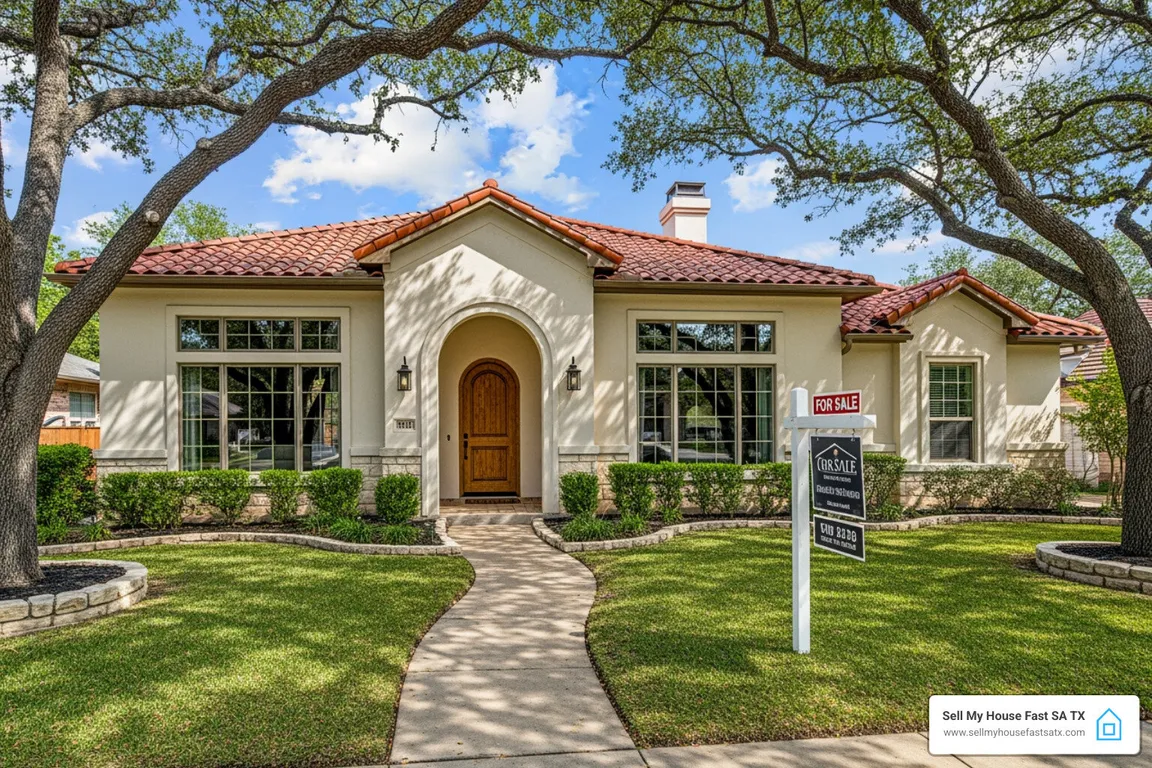

A homestead exemption isn’t a coupon you carry around in your wallet. It’s tied to one house, one tax year, and the person who owned and lived in that house on January 1. Sellers all over San Antonio figure this out in the fall, when a tax statement shows up and the numbers look nothing like last year’s.
Bexar County Homestead Exemption Deadlines and Payment Options
There’s a cutoff, and selling in the middle of the year doesn’t move it.
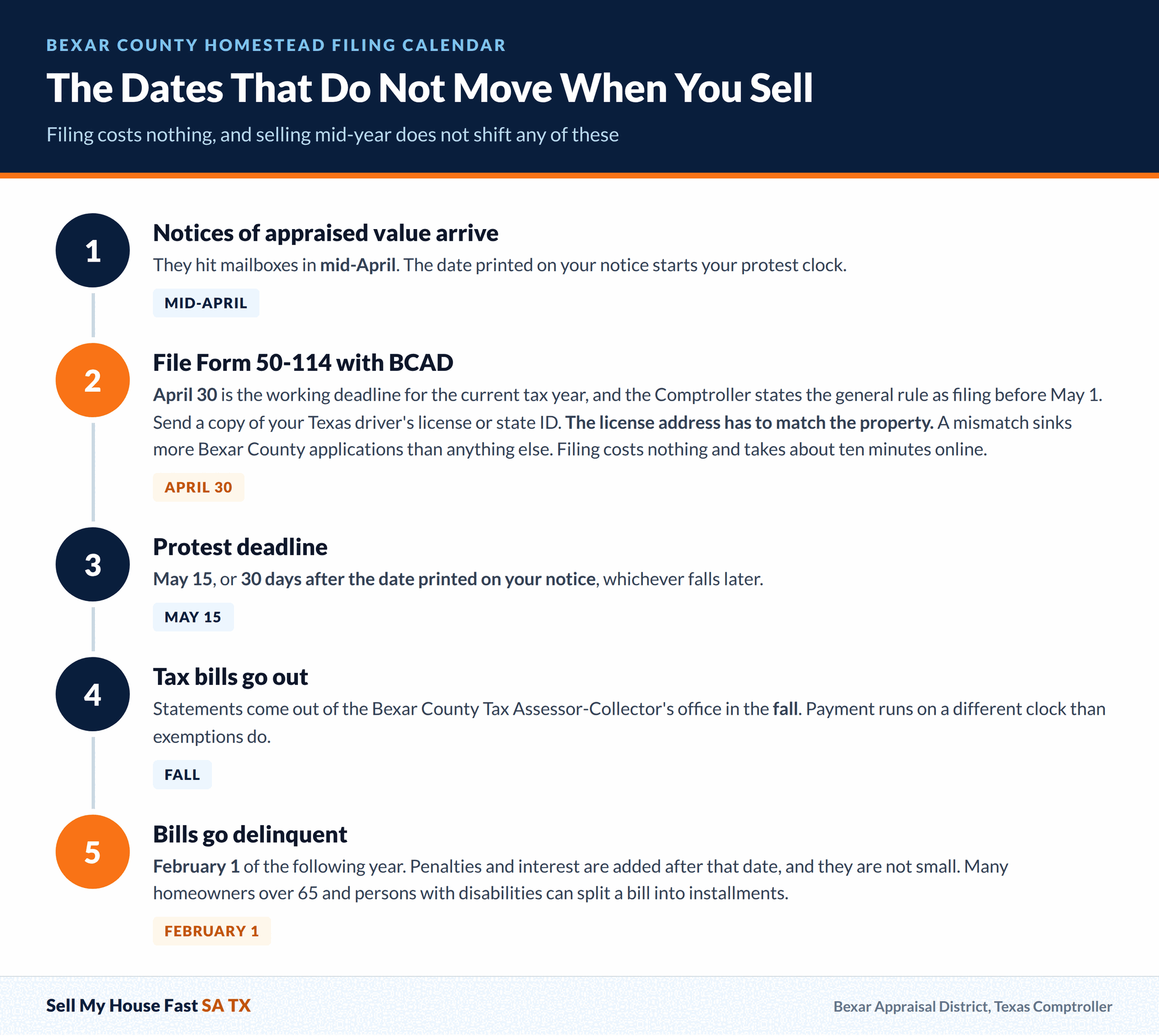
April 30 is the working deadline for getting a residence homestead exemption applied to the current tax year. Bexar Appraisal District is where it goes. The Texas Comptroller states the general rule as filing before May 1, and you can read that language on the state’s property tax exemptions page. Filing costs nothing. You submit Form 50-114 to BCAD with a copy of your Texas driver’s license or state ID.
Toss any letter offering to file your homestead paperwork for a modest “processing fee.” A private outfit is pulling your name off recorded deeds. The form takes about ten minutes online.
One mistake sinks more Bexar County applications than any other: the address on your driver’s license doesn’t match the property. Update your license first, then file. Otherwise you’re waiting on a correction letter while the calendar burns.
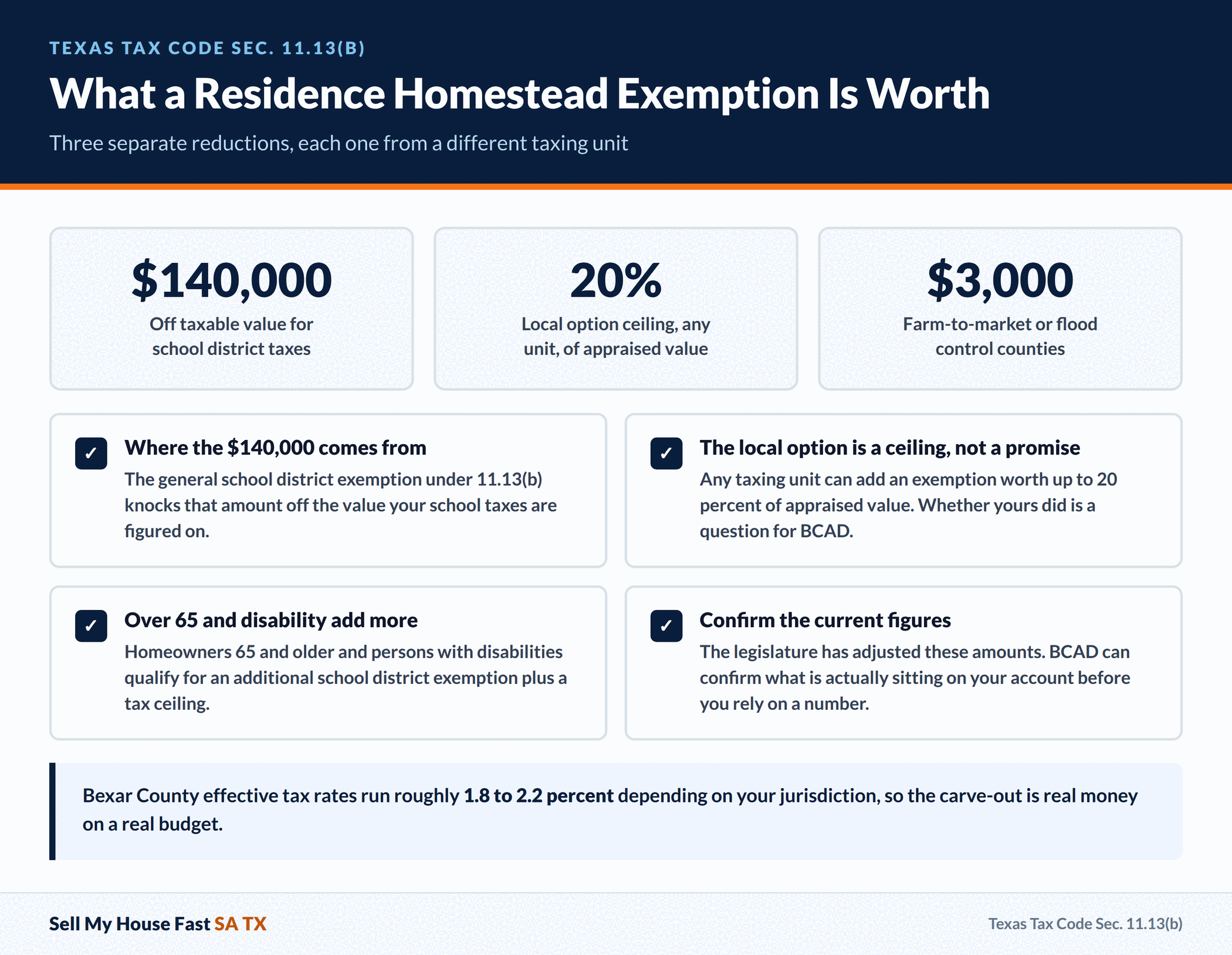
Under Tax Code 11.13(b), the general school district exemption knocks $140,000 off your taxable value for school taxes. Any taxing unit can add a local option exemption worth up to 20 percent of appraised value. Counties collecting farm-to-market or flood control taxes provide a $3,000 exemption. Homeowners 65 and older and persons with disabilities qualify for an additional school district exemption plus a tax ceiling. BCAD can confirm the current amount for your account, since the legislature has adjusted those figures.
Notices of appraised value hit mailboxes in mid-April. Your protest deadline is May 15 or 30 days after the date printed on that notice, whichever falls later.
Payment works on a different clock than exemptions. Bills come out of the Bexar County Tax Assessor-Collector’s office in the fall, and they go delinquent February 1 of the following year. Penalties and interest are added after that date, and they aren’t small. Certain homeowners, including many over 65 and persons with disabilities, can split their bill into installments, and the tax office will tell you whether your account qualifies.
Bexar County effective tax rates run roughly 1.8 to 2.2 percent depending on your jurisdiction. That carve-out is real money on a real budget.
What Happens to Your Bexar County Homestead Exemption When You Sell Your Home
Your exemption doesn’t ride along in the moving truck.
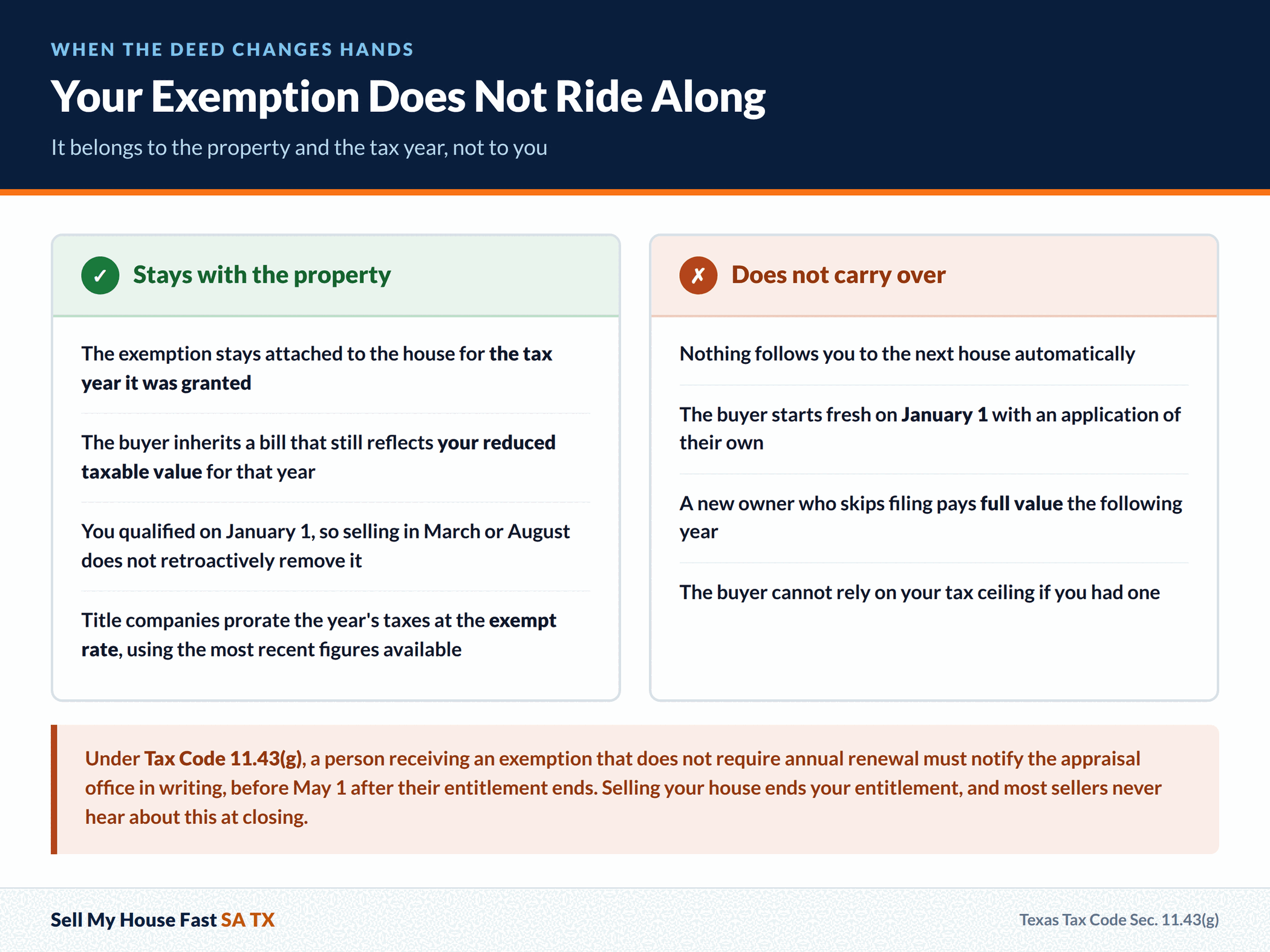
It stays attached to the house for the tax year it was granted. The buyer inherits a tax bill that still reflects your reduced taxable value for that year, then they start fresh on January 1 with an application of their own. None of it carries over, so a new owner who skips filing pays full value the following year.
You also carry a duty most sellers never hear about at closing. Under Tax Code 11.43(g), a person receiving an exemption that doesn’t require annual renewal must notify the appraisal office. The notice goes in writing, before May 1 after their entitlement ends. You can read the statute language at Findlaw’s copy of Section 11.43. Selling your house ends your entitlement. A quick written notice to BCAD closes the loop and keeps an exemption from sitting on a property you no longer own.
Watch the proration line on your settlement statement. Title companies split the year’s taxes between seller and buyer using the most recent figures available, and those figures include your homestead reduction. The buyer’s real bill can land higher than the proration suggested, which is where post-closing phone calls start.
A while back I sat down with a young couple in Converse who were three months behind on their mortgage with an auction date already set. Their kitchen table held a stack of certified letters. A lawn mower they’d been trying to sell was still sitting in the garage. We closed in under three weeks and their exemption stayed exactly where it was, on a house that was no longer their problem. Homeowners in that spot often call Sell My House Fast SA TX. A posted sale date doesn’t care about a 58-day average listing timeline.
The 58-day figure is real, by the way. Redfin’s San Antonio market data showed homes selling in about 58 days for the three months ending August 2026. The median sale price was $265,000, down 1.9 percent from a year earlier. Add financing and closing time on top of the marketing period. If a foreclosure sale is scheduled, the exemption question isn’t your emergency; the deadline is.
What Happens If You Buy a New Home in Bexar County Mid-year
Closing on a house in July feels like it should come with a July tax break. Sign the deed, move in, file the form, save money. The sequence breaks in one specific place, and plenty of buyers assume otherwise. Everything turns on whether the seller already had a general homestead exemption on the property as of January 1.
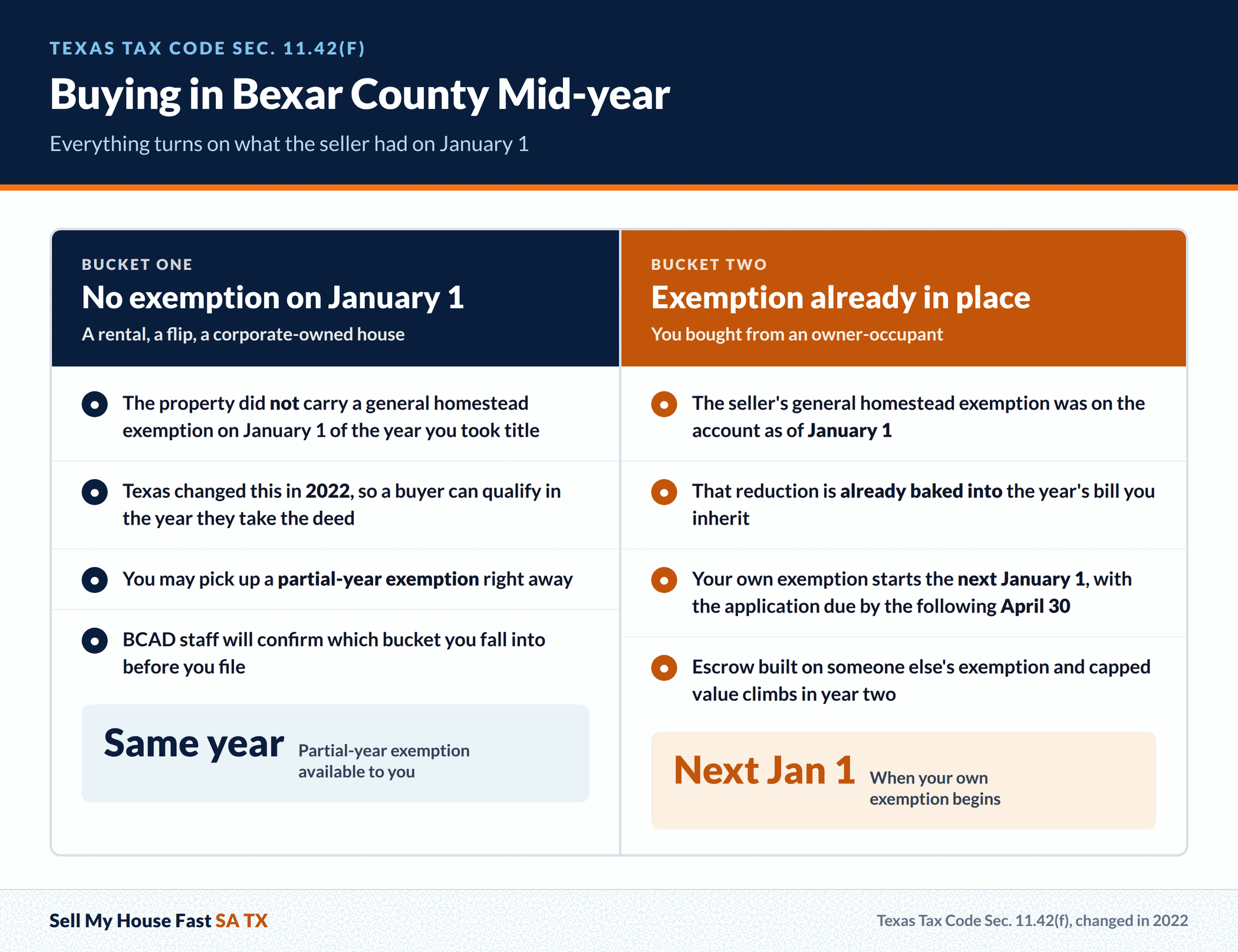
Texas changed this in 2022. Under Tax Code 11.42(f), a buyer can qualify for a residence homestead exemption in the year they take title. That works only if the property didn’t carry that exemption on January 1 of that year. Buy a rental, a flip, or a corporate-owned house, and you may pick up a partial-year exemption right away. Buy from an owner-occupant who already had the exemption in place, and the reduction is already baked into that year’s bill. Your own exemption starts the next January 1, and the application is due by the following April 30. BCAD’s staff will confirm which bucket you fall into before you file.
New owners get hurt right here. Your lender builds the first year of escrow around a tax bill shaped by someone else’s exemption and someone else’s capped value. Year two arrives without that cap, your assessed value resets to market, and the monthly payment climbs. Nobody at the closing table usually mentions that.
Homeowners 65 and older or receiving the disability exemption get a genuine portability benefit, and the school tax ceiling travels with you as a percentage. You request a tax ceiling certificate from the appraisal district where your old home sat, then apply for the exemption on the new property. If county, city, or junior college units adopted a ceiling and you stay within the same taxing unit, those can transfer too. Veterans rated 100 percent disabled by the VA carry a total exemption on their residence homestead, and it applies to the new home once approved.
Movers within Bexar County have room to negotiate right now. August 2026 saw 3,011 San Antonio homes close, down from 3,156 the year before. Buyers aren’t fighting for scraps. The slack cuts both ways. It helps you buy, and it stretches how long your old house sits waiting on the right offer. I’ve seen that slow down even well-priced listings.
Do You Have to Reapply for Your Bexar County Homestead Exemption Every Year
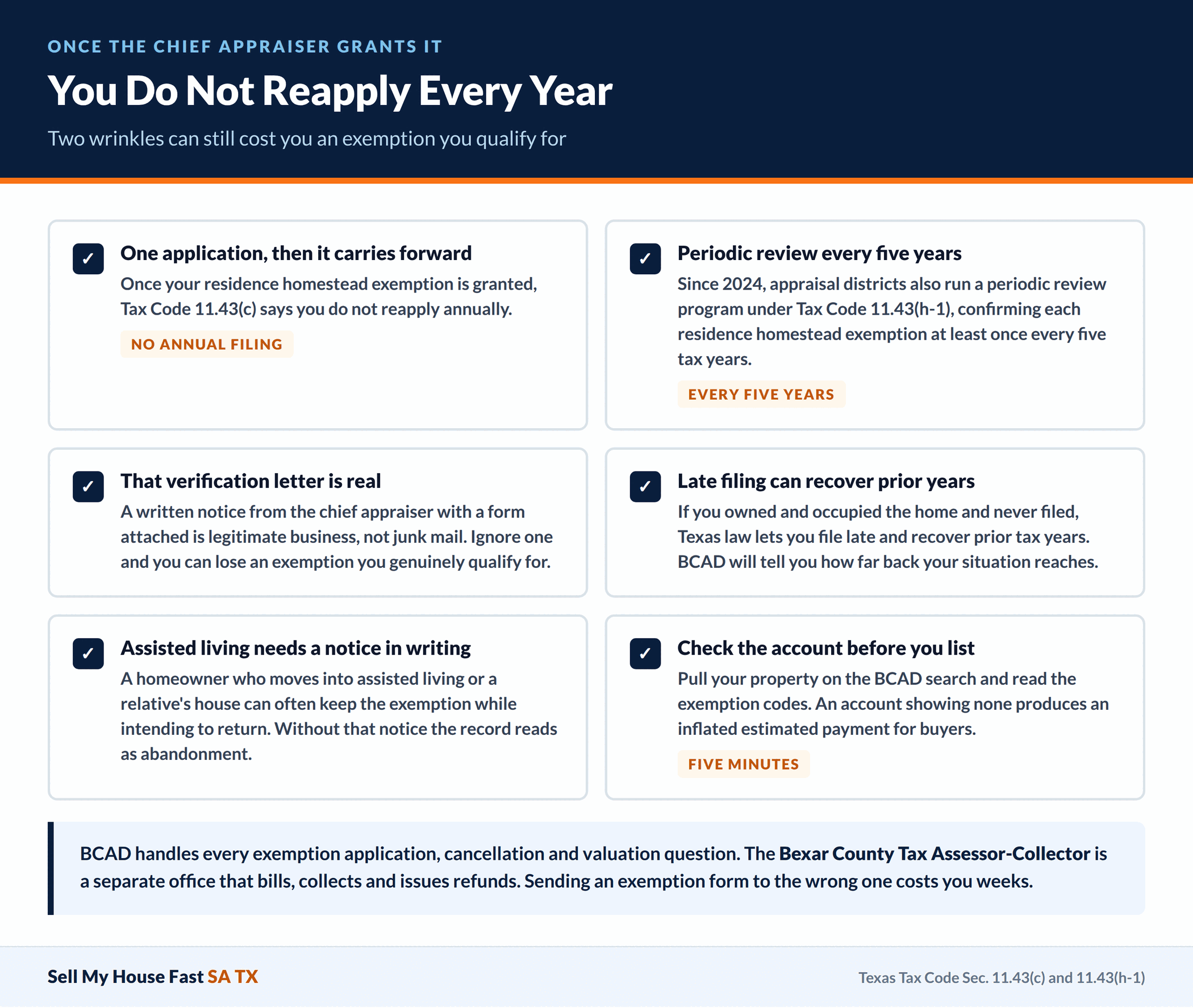
No, and nobody at BCAD is going to quietly delete it on you. Once the chief appraiser grants your residence homestead exemption, Tax Code 11.43(c) says you don’t reapply annually. Texas Law Help lays it out the same way: one application, then it carries forward.
There are two wrinkles worth knowing.
You might get a written notice from the chief appraiser, form attached, demanding a new application. Since 2024, appraisal districts also run a periodic review program under Tax Code 11.43(h-1), confirming each residence homestead exemption at least once every five tax years. So a letter asking you to verify your exemption is legitimate business, not junk mail. Ignore one and you can lose an exemption you genuinely qualify for.
Bexar County homeowners sometimes discover the exemption was never on the account in the first place. Pull up your property on the BCAD search and look at the exemption codes. If you owned and occupied the home and never filed, Texas law lets you file late and recover prior tax years. The refund comes through the tax assessor-collector’s office. BCAD will tell you how far back your specific situation reaches, because the window depends on delinquency dates rather than a simple count of calendar years.
If you’re the one selling, this affects your listing too. Buyers and their agents pull the tax record early, and an account showing no homestead exemption produces an inflated estimated payment. I’ve watched that single line item cool off interest on otherwise clean houses in places like Leon Valley and the Medical Center area. Verifying your exemption status before you list costs you five minutes.
One more thing trips up families. A homeowner who moves into assisted living or a relative’s house can often keep the exemption while intending to return. The appraisal district needs to hear about it in writing, because without that notice the record simply reads as if the home was abandoned.
The Bottom Line on Bexar County Homestead Exemptions After a Home Sale
People ask me this sideways at almost every kitchen table. Should you time a sale around your exemption?
Rarely. The savings are annual and modest compared to what a slow sale costs you, so run the arithmetic on holding a house in this market. Freddie Mac’s survey put the 30-year mortgage rate near 6.66 percent for the week of July 30, 2026. Add insurance, utilities, and taxes. That runs well past what any single-year exemption puts back in your pocket. Two extra months of carrying costs on a mid-priced San Antonio house wipes out the entire school tax reduction.
January 1 does deserve your attention. Ownership and occupancy on that date determine who qualifies for the year. Selling in December versus January changes which household claims the exemption and how the title company prorates. If you’re already planning a first-quarter sale, ask your closer to walk you through both scenarios before you pick a closing date.
Skip the panic about “losing” anything. You didn’t lose an exemption by selling; you ended your entitlement on that property, and you’ll establish a new one on your next primary residence. That’s how the system was built to work.
Sellers really get burned by delay. They wait for a tax year to turn over. They wait for one more appraisal cycle, or for a price a cooling market isn’t offering. Owners facing probate, divorce, job relocation, or a payment they can’t make need certainty on a date, not a tax strategy. That’s the situation where a direct cash offer from a local buyer like Sell My House Fast SA TX beats a listing. You pick the closing day, and the exemption question resolves itself.
Selling as-is doesn’t forfeit anything on the tax side. Condition affects price, not exemption eligibility.
Where to Find More Bexar County Property Tax Resources
A widow on the far East Side called me after her tax bill jumped by more than half in one year. Her husband’s over-65 exemption had come off the account after his death, and nobody had told her about the surviving spouse provisions or the ceiling she may have been able to keep.
That call is the reason I push people toward primary sources instead of neighborhood chatter. BCAD handles every exemption application, cancellation, and valuation question for property inside Bexar County. That covers Alamo Heights, Somerset, and the ranch land out past Loop 1604. Their downtown office sits on North Frio Street, and applications also go in by mail, though I always send mine certified just to be safe. The Bexar County Tax Assessor-Collector is a separate office entirely; they bill, collect, and issue refunds. Sending an exemption form to the tax office instead of the appraisal district costs you weeks.
For statewide rules, the Comptroller’s Property Tax Assistance Division publishes a plain-language residence homestead exemptions guide. It covers eligibility, the over-65 and disability provisions, and the transfer rules for surviving spouses. Read it once before you call anyone. Fifteen minutes with that document will save you from half the bad advice floating around Facebook groups and family text threads.
One more note on records. Keep a copy of every exemption application you submit, along with the date you sent it. BCAD processes tens of thousands of forms a year, and the burden of proving you filed on time falls on you, not on them.
Frequently Asked Questions
Do I Have to Cancel My Homestead Exemption When I Sell My House in San Antonio?
You don’t file a cancellation form in most cases. The deed transfer tells BCAD the property changed hands, and the exemption comes off the account for the following tax year. If you’ve already claimed a homestead on a new property, notify BCAD about the old one, since two exemptions under the same owner name trigger a review.
Will My Buyer Get My Homestead Exemption for the Rest of the Year?
The exemption stays on the property through the end of the tax year it was granted for, which is why closing statements prorate taxes at the exempt rate. The buyer then applies in their own name for the next year based on January 1 ownership and occupancy. They aren’t inheriting your exemption permanently, and they can’t rely on your tax ceiling if you had one.
Can I Keep My Over-65 Tax Ceiling If I Sell and Buy Another Home in Bexar County?
You can transfer the percentage benefit of your school tax ceiling to a new homestead in Texas, but it doesn’t move over as the same dollar amount. You request a certificate from BCAD showing your ceiling on the old property, then file it with the appraisal district where your new home sits. Surviving spouses age 55 or older have their own set of rules worth reading before making any move.
Does a Homestead Exemption Affect How Much I Can Sell My House For?
No. Buyers pay for location, condition, and timing. The exemption is an owner-specific tax benefit, not a feature of the property, and it never shows up in a comparable sales analysis. A house with an exemption and an identical one without it appraise the same.
What Happens to My Homestead Exemption If I Sell After January 1?
You qualified on January 1, so the exemption applies to that full tax year on that property. Selling in March or August doesn’t retroactively remove it. Your proration at closing reflects the exempt amount, and the buyer takes over from the closing date forward, at those same numbers, until the next year’s assessment.
Is It Better to Wait Until the New Tax Year to Sell?
Almost never. A month or two of mortgage interest, insurance, utilities, and maintenance costs more than the tax difference on a typical San Antonio home. If your reason for selling involves a deadline, a lender, or a family situation, the calendar argument falls apart fast.
If you’re weighing a sale and the tax side still feels murky, take it one step at a time. Pull your account on the BCAD site, look at what exemptions are actually listed, and figure out your real timeline before anything else. When you’re ready to talk numbers on your specific house, reach out. Maybe you just want a straight answer about what a fast closing would look like. No pressure, no listing agreement, and no obligation to do anything with the information once you have it.
What the San Antonio Market Adds to the Exemption Question
Exemption rules read the same in every Bexar County zip code. The market is what decides how long you hold the house while you sort them out. Homes here sold in about 58 days over the three months ending August 2026, and the median sale price came in at $265,000. Stretch that out with a financing period and a repair list, and you’re covering taxes, insurance, and interest on a house you already decided to leave. That’s the part we walk through first with a San Antonio homeowner, before anybody pulls up a tax record.
January 1 still matters, so it’s worth knowing which side of it your closing lands on. Once you have that date in mind, the exemption math usually settles itself.
Talk Through Your House and Your Timeline
If the tax side still feels murky, or you’re closer to selling than to filing, we’re glad to look at your situation with you. We buy houses across San Antonio and the surrounding towns in as-is condition, and you pick the closing date. Nothing gets signed to hear a number, and there’s no listing agreement involved. You can reach us any time through our contact page. Or just fill out the form below with your address, and we’ll follow up with what a cash sale on your house would look like.