

Are you wondering, “Can I sell a house with a spouse in jail?” The answer is yes, but it involves navigating legal steps and emotional problems. Here’s what you need to know:
- Legal Approval: Secure the necessary legal permissions, like signatures or power of attorney, to proceed with the sale.
- Joint Ownership Rules: Assess property ownership structure to understand consent requirements.
- Legal Guidance: Consult a real estate attorney for advice and ensure all legal requirements are met.
- Court Intervention: Consider court measures if mutual agreement on the sale is unattainable.
Selling a house with a spouse in jail can feel like an uphill battle. It’s not just a legal process—there’s a significant emotional impact as well. For the spouse outside, agreeing on what to do with a home full of memories can be heart-wrenching. Additionally, the imprisoned spouse may feel a loss of control or input in decisions about the property. Balancing these emotions while ensuring that all legalities are addressed can be complex and overwhelming.
I’m Daniel Cabrera, with over 16 years of experience helping homeowners through tough situations like selling a house with an incarcerated spouse. If you’re unsure about the process, I can guide you toward a solution that respects everyone’s rights.
At Sell My House Fast SA TX, we make it easy to sell your house quickly and without hassle. Whether you need a fast sale, legal guidance, or want to avoid repairs, we’re here to help.
Ready to explore your options? Request a no-obligation cash offer today and close in as little as one week.

Understanding Property Ownership Laws
When it comes to selling a house, especially if your spouse is in jail, understanding property ownership laws is crucial. These laws determine who has the right to sell and what permissions are needed. Let’s break down the key types of ownership:
Joint Ownership
Joint Tenancy: In joint tenancy, both spouses own the property equally. If one spouse is in jail, the other can still sell the house. However, the consent of the incarcerated spouse is usually required unless a legal workaround, like a court order, is obtained.
Tenants in Common: Here, each spouse owns a specific share of the property. This means you can sell your share without the other’s consent, but selling the entire property typically requires agreement from both parties.
Community Property
In community property states, any property acquired during the marriage is owned equally by both spouses. This means you generally need your spouse’s permission to sell the house, even if they are incarcerated. States like California and Texas fall under this category, so if you’re in San Antonio, TX, understanding these laws is essential.
Tenancy by the Entirety
This ownership is exclusive to married couples. The property is viewed as a single legal entity owned by both spouses. Neither can sell without the other’s consent, making it crucial to get approval from an imprisoned spouse or seek court intervention.
Why This Matters
Understanding these ownership types helps you know if you need your spouse’s consent or if you can proceed independently. It also informs you about the legal routes available if disputes arise. For example, if you find yourself asking, “Can I sell a house with a spouse in jail?”, knowing your state’s property laws gives you a clearer path forward.
If you’re navigating this complex situation, consider consulting a real estate attorney. They can provide guidance specific to your circumstances, ensuring that all actions comply with legal requirements.
In the next section, we’ll explore solutions for selling property when one spouse is incarcerated, including options like cash buying companies and legal interventions.
Can I Sell a House with a Spouse in Jail?
Selling a house when your spouse is in jail can feel overwhelming, but understanding your legal options can simplify the process. Let’s explore the key aspects you need to consider: legal rights, power of attorney, and court-ordered sales.
Legal Rights
When your spouse is incarcerated, their legal rights to the property remain intact. This means they still have a say in what happens to jointly owned property. If you’re asking, “Can I sell a house with a spouse in jail?”, the answer depends on the type of property ownership and state laws. In San Antonio, TX, for instance, community property laws mean both spouses have equal ownership of the home acquired during the marriage. This makes your spouse’s consent crucial unless you take legal steps to bypass it.
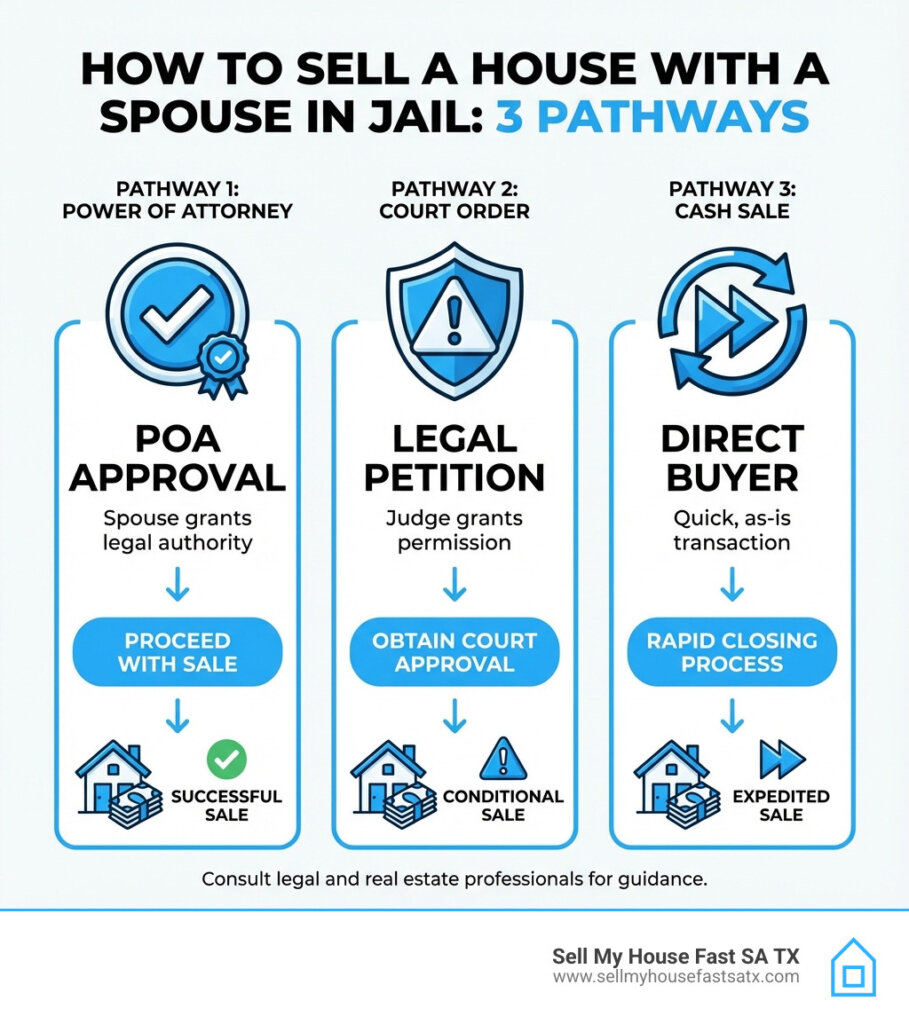
The Cooperative Path: Using a Power of Attorney (POA)
If your incarcerated spouse is willing to cooperate with the sale of your San Antonio home, the most straightforward and often fastest path is to use a Power of Attorney (POA). A POA is a legal document that grants one person (the agent or attorney-in-fact) the authority to act on behalf of another person (the principal) in legal and financial matters.
What is a Power of Attorney and How it Works in Texas Real Estate?
For a real estate transaction, you’ll need a specific Power of Attorney that explicitly grants you the authority to sell the property. A general POA might not be sufficient for such a significant transaction. This document empowers you to sign all necessary closing documents, deeds, and other paperwork on your spouse’s behalf, effectively allowing the sale to proceed as if they were physically present. For more detailed information on real estate POAs, you can consult resources like Free Real Estate Power of Attorney Form.
Using a POA can significantly simplify the process, especially when working with a cash buyer like Sell My House Fast SA TX. We understand these situations and can guide you through the process, ensuring the POA is properly executed and accepted.
How to Get a Power of Attorney from an Incarcerated Spouse
Obtaining a POA from an incarcerated spouse requires careful coordination, but it is certainly doable:
- Contact the Correctional Facility: Reach out to the prison or jail administration in Texas where your spouse is held. Inquire about their specific procedures for inmates signing legal documents. They will inform you about visiting hours for legal matters, approved notaries, and any security protocols.
- Draft the POA Document: This is where a real estate attorney becomes invaluable. They can draft a POA that is legally sound, specific enough for a property sale in Texas, and meets all the requirements of title companies and lenders. This ensures the document will be accepted without issue, preventing delays in your San Antonio home sale.
- Arrange for a Mobile Notary: Once the POA is drafted, you’ll need to arrange for a mobile notary to visit the correctional facility. The notary will witness your spouse’s signature, verify their identity, and notarize the document, making it legally binding. Again, the facility will have rules regarding notary visits.
- Ensure Legal Soundness: An experienced real estate attorney will ensure the POA is correctly worded, executed, and recorded if necessary, protecting both your interests and the validity of the sale. This is especially important in San Antonio, where we have specific legal requirements for real estate transactions.
If you’re also navigating a divorce, a POA can be part of the solution. We have resources on “Selling House During Divorce” that can offer additional insights.

Executing the Sale with a POA
Once you have a valid and notarized POA, you can proceed with the sale:
Distributing the Proceeds: After the sale closes and all mortgages and liens are paid, the proceeds will typically be distributed according to the ownership interest. It’s crucial to keep communication open with your spouse about these financial arrangements.
Signing Closing Documents: You, as the attorney-in-fact, will sign all necessary closing documents on your spouse’s behalf.
Working with the Title Company: The title company will review the POA to ensure its validity and scope. They will need to be confident that you have the legal authority to act.
When You Need Legal Help: Court-Ordered Sale
What if your incarcerated spouse won’t cooperate or grant a Power of Attorney? In these cases, you may need to pursue a court-ordered sale through a partition lawsuit. This is a last resort due to its complexity, cost, and time commitment.
What is a Partition Lawsuit and When is it Necessary?
A partition lawsuit is a legal action to divide jointly owned property. Since a house can’t be physically split, the court can order it to be sold and the proceeds divided among the owners.
This becomes necessary when your spouse refuses to consent to the sale, won’t grant a POA, or if you’re facing financial hardship like foreclosure and need to sell.
A partition lawsuit can be a standalone option, but it often accompanies divorce proceedings in these situations. If your spouse won’t sign off on a sale, a court order may be your only path forward.
How a Court-Ordered Sale Works in Texas
Here’s a general overview of the process in Bexar County for San Antonio properties:
- File a Petition: You’ll file a “petition for partition” with the local court, explaining why the sale is necessary.
- Serve Your Spouse: Your incarcerated spouse must be formally served with the lawsuit.
- Prove Your Case: You must present evidence to the court showing the necessity of the sale, such as financial hardship.
- Get Legal Representation: A real estate attorney is essential for this complex process. Courts can order a sale and even appoint a clerk to sign if a party refuses, making a skilled Foreclosure Attorney San Antonio critical.
- Receive a Court Order: If the court agrees, it will issue an order for the property’s sale.
- Sell and Distribute: The property is sold, and the proceeds are divided as per the court’s order after all fees and debts are paid.

Downsides of a Partition Lawsuit
While a court order provides a legal path, it has significant drawbacks:
Financial Risks: If you refuse to sell when your partner wants to, they can also pursue a court order, leading to more complications, especially if you’re trying to answer, “Can I Sell My House to Avoid Foreclosure?”.
Lengthy Timeline: Court processes are slow, often taking months or years.
High Legal Fees: Attorney and court costs can consume a large portion of the sale proceeds.
Emotional Stress: Legal battles are emotionally draining.
Lower Sale Price: Court-ordered sales may not achieve the best price compared to a cash sale.
Solutions for Selling Property with an Imprisoned Spouse
When facing the challenge of selling a house with a spouse in jail, it’s important to know your options. Here are some practical solutions that can help simplify this complex process.
Cash Buying Companies
Cash buying companies can be a quick solution when you’re dealing with a spouse in jail. These companies buy properties directly for cash, which means you can avoid the lengthy traditional sale process.
- Speed: They often close deals in as little as a week.
- Convenience: No need for repairs or showings; they buy homes “as-is.”
- Certainty: Offers are not dependent on financing, reducing the risk of deals falling through.
In San Antonio, TX, Sell My House Fast SA TX is a Cash Buying Company that specializes in fast transactions, helping you get a fair cash offer quickly. This can be especially beneficial if you’re facing financial pressures like mortgage payments or foreclosure.
Real Estate Attorney
Having a real estate attorney on your side can make a big difference. They can provide legal advice and ensure all documents are correctly prepared and signed. This is crucial when dealing with the legal complexities of selling property with an imprisoned spouse.
- Interpretation and Compliance: Attorneys understand state laws and ensure you follow them.
- Document Preparation: They handle all necessary paperwork.
- Representation in Court: If needed, they can represent you in court for a sale order.
Hiring a seasoned attorney in San Antonio can give you peace of mind and protect your interests throughout the sale process.
Court Intervention
If your spouse is uncooperative, court intervention might be necessary. This involves filing a petition to request a court-ordered sale.
- Petition Filing: You’ll need to explain why selling is necessary, such as financial hardship.
- Hearing: A judge will hear your case and decide if selling is in both parties’ best interest.
- Court Order: If approved, the court will authorize the sale.
While this option can be time-consuming and costly, it’s a viable path if other solutions aren’t possible. Be prepared for a detailed legal process and consider seeking legal representation to steer it effectively.
Key Takeaways
- Cash Buying Companies: Offer speed and certainty in selling “as-is.”
- Real Estate Attorney: Provides legal expertise and representation.
- Court Intervention: A necessary step if your spouse won’t cooperate.
Exploring these solutions can help you manage the sale of your home under challenging circumstances. In the next section, we’ll dig into the financial and emotional considerations involved in this process.
Financial and Emotional Considerations
Selling a house when your spouse is in jail involves more than just legalities. It’s essential to think about the financial and emotional aspects too. Let’s break it down into simple parts.
Mortgage Payments
When one spouse is incarcerated, the responsibility of mortgage payments often falls on the other. This can be challenging, especially if the household income is reduced.
- Communication with Lenders: It’s crucial to contact your mortgage lender. Explain your situation. Some lenders may offer temporary relief options, like loan modifications or forbearance, until you sell the house.
- Budgeting: Re-evaluate your finances to ensure you can cover the mortgage and other expenses. This might involve cutting unnecessary costs or finding additional income sources.
Capital Gains Tax
If you sell the house, there’s a chance you might face capital gains tax. This tax applies to the profit from the sale.
- Primary Residence Exclusion: If you’ve lived in the house as your main home for at least two of the last five years, you might be able to exclude up to $250,000 (or $500,000 if married) from capital gains tax.
- Consult a Tax Professional: It’s wise to talk to a tax advisor to understand your specific situation. They can help you calculate potential taxes and explore any deductions you might qualify for.
Emotional Impact
Selling a home is an emotional journey, even more so when a spouse is in jail.
- Attachment to the Home: Both you and your spouse might have strong emotional ties to the house. It’s important to communicate openly about the sale to avoid additional stress.
- Support Systems: Lean on friends and family for support. Sharing your feelings and getting advice can help you through this tough time.
- Counseling: Consider seeking professional counseling to manage the emotional strain. It can provide tools to cope with the challenges you’re facing.
By understanding these financial and emotional considerations, you can make informed decisions that align with your needs and circumstances. In the next section, we’ll address frequently asked questions about selling a house when your spouse is in jail.
Frequently Asked Questions about Selling a House with a Spouse in Jail
Can an incarcerated person sign legal documents for property sale?
Yes, an incarcerated person can sometimes sign legal documents related to a property sale. However, this depends on the rules of the correctional facility and the legal framework in your state.
- Power of Attorney: If the incarcerated spouse has granted a power of attorney to someone, that person can sign the documents on their behalf. It’s a common solution when direct signing isn’t possible.
- Legal Representation: In some cases, a lawyer can help facilitate the signing of documents. It’s crucial to consult with a legal expert to ensure all actions are valid and binding.
What happens to jointly owned property if one owner is in jail?
Jointly owned property can be complicated if one owner is incarcerated. The rights of the incarcerated spouse remain intact, but their ability to participate in decisions about the property might be limited.
- Consent for Sale: Typically, both owners must agree to sell the property. If the incarcerated spouse cannot or will not consent, legal intervention might be necessary.
- Court Intervention: You may need to seek a court order to proceed with the sale. This involves filing a petition and proving why the sale is necessary, such as financial hardship.
What are the implications of refusing to sell a home when one partner is in jail?
Refusing to sell can lead to foreclosure if you cannot maintain mortgage payments, which damages both spouses’ credit. The incarcerated spouse could also file a partition lawsuit to force the sale, prolonging the financial and emotional stress.
What if I need to sell outside San Antonio or San Marcos?
Sell My House Fast SA TX specializes in the San Antonio, San Marcos, and surrounding markets. This focus allows us to provide the best possible service to local homeowners. If your property is outside this area, please contact us, and we can discuss your specific situation to see how we might be able to help.
How can I sell a jointly owned property without my spouse’s permission?
Selling a jointly owned property without the other spouse’s permission is challenging but possible in certain situations.
- Legal Action: You might need to pursue a partition sale. This legal process allows the sale of the property and divides the proceeds between the owners. It’s often used when co-owners cannot agree on what to do with the property.
- Court Order: If the incarcerated spouse is uncooperative, obtaining a court order might be the only option. This requires demonstrating the necessity of the sale to a judge.
Understanding these frequently asked questions can help you steer the complexities of selling a house when your spouse is in jail. In the next section, we’ll explore how Sell My House Fast SA TX can offer solutions custom to your needs, especially if you’re in San Antonio, TX.
A Simple Solution for a Complicated Problem
We understand that facing legal problems, financial pressure, and emotional stress when selling your San Antonio house with an incarcerated spouse is incredibly tough. But remember, you have options, and you don’t have to steer this alone.
For a guaranteed, fast, and hassle-free sale that bypasses the courts and complex paperwork, Sell My House Fast SA TX is your best choice. With over 16 years of experience helping San Antonio homeowners in these difficult situations, we handle the complexities so you can move forward with peace of mind.
✅ Request your no-obligation cash offer for your San Antonio house today!